Knowledge hub

Binding Problem: Creating Unified Experiences from Distributed Representations

Binding Problem: Creating Unified Experiences from Distributed Representations

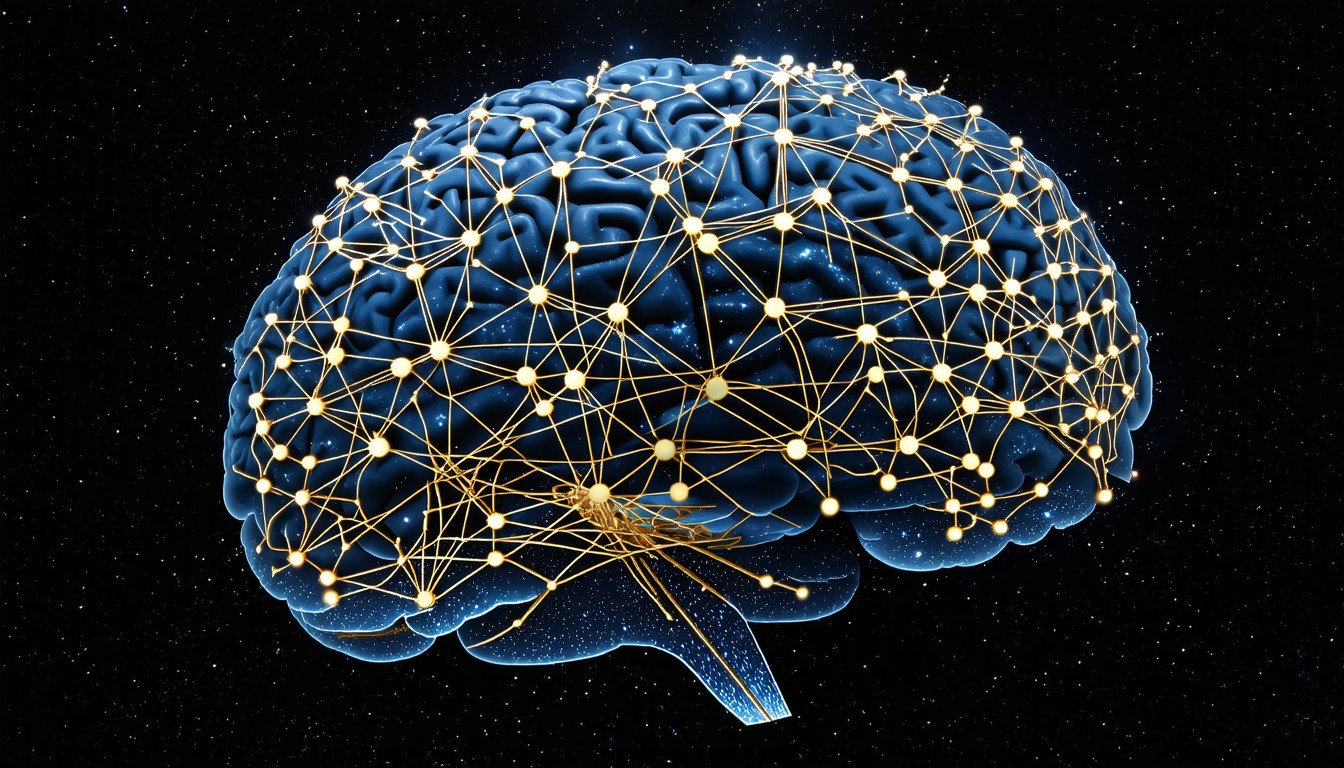
The binding problem constitutes a key inquiry into how distinct neural populations processing disparate features of a stimulus combine their activity to generate a unified perceptual experience. This challenge arises because biological neural systems encode sensory attributes such as color, motion, shape, and sound in anatomically separate regions, requiring a mechanism to associate these distributed features correctly without confusion. A visual scene contains multiple objects, each possessing a unique combination of attributes, and the brain must link the specific color of one object to its specific motion and shape while segregating these from the attributes of adjacent objects. This setup is essential for higher cognitive functions, including object permanence, which allows an organism to track objects as they move behind occluders, and causal reasoning, which depends on understanding the interaction between distinct entities over time. Scene comprehension relies entirely on this capacity to synthesize fragmented sensory inputs into coherent wholes, enabling an organism to handle and interact effectively with a complex environment. Neural activity representing these different features occurs in anatomically distinct brain regions specialized for specific types of processing.

Early visual cortices decompose the retinal image into basic components like orientation, spatial frequency, and color opponency, while auditory cortex decomposes sound into frequency and timing. The spatial separation of these processing streams creates a logistical difficulty for the system, as information regarding a single entity is distributed across a vast network. To solve this, the brain employs mechanisms of temporal synchrony, involving the precise timing of neural firing across disparate regions, to signal which neuronal activities belong together. When neurons in different areas fire action potentials in a synchronized manner, they indicate that they are processing different aspects of the same stimulus. Gamma-band oscillations, rhythmic electrical activity between 30 and 100 Hz, serve as a primary candidate for this synchrony in biological systems, providing a temporal reference frame that binds spatially distributed neural assemblies into a coherent object representation. Convergence zones in higher-order cortical areas receive inputs from multiple modalities to combine information into stable percepts.

These zones do not necessarily store the detailed features themselves but act as indices or pointers that link the activated feature maps in lower-level cortices. This hierarchical organization allows for efficient processing where low-level areas handle high-resolution data, and high-level areas manage the relationships between these data points. Predictive coding frameworks complement this by using top-down signals to align feature representations based on prior expectations. In this view, the brain constantly generates predictions about incoming sensory data and only processes the deviation from these predictions, or prediction errors. Binding occurs when the bottom-up sensory data matches the top-down prediction, effectively locking the representation into a coherent state that minimizes surprise. This process must remain energetic and context-sensitive to handle multiple objects simultaneously without cross-talk, ensuring that the features of object A do not become erroneously linked to object B even when they are spatially proximate or visually similar.

Early sensory cortices encode basic attributes like orientation and pitch in localized populations of neurons that respond selectively to specific low-level features. These local representations are then passed to intermediate areas, which combine related features based on Gestalt principles or learned statistical regularities. Gestalt principles such as proximity, similarity, and continuity guide the initial grouping of features, providing a heuristic framework for pre-attentive segmentation. Learned statistical regularities refine this process by exploiting correlations in the environment, such as the fact that certain colors and shapes co-occur frequently. Higher associative regions integrate these grouped features into stable object representations modulated by attention, allowing the system to prioritize relevant stimuli and suppress irrelevant background noise. Attention acts as a spotlight that enhances the synchronization of neurons representing the attended object while desynchronizing those representing distractors, thereby sharpening the boundaries of the bound representation.

Multisensory inputs such as sight and sound undergo temporal and spatial alignment to form a unified event percept, a process critical for handling the real world where events rarely occur in a single modality. The brain solves the correspondence problem by determining which auditory signal pairs with which visual event based on temporal coincidence and spatial congruence. Working memory maintenance holds these bound representations active to support reasoning and decision-making over extended periods. Without this sustained activity, the bound percept would disintegrate immediately upon stimulus offset, preventing the organism from using past information to guide future actions. Distributed representation encodes information across many neurons rather than in a single locus, providing reliability against damage and allowing for generalization across similar stimuli. Coherence refers to the perceptual stability and internal consistency of a bound representation over time, ensuring that an object is perceived as continuous despite changes in lighting, viewpoint, or occlusion.

Misbinding involves erroneous association of features from different objects, leading to illusory conjunctions, a phenomenon often observed when attention is overloaded or divided. This highlights the fallibility of the binding mechanism and its dependence on limited cognitive resources. Early 20th-century Gestalt psychology identified perceptual grouping laws without identifying neural mechanisms, providing a descriptive account of perception that lacked explanatory power regarding biological implementation. Research in the 1980s and 1990s identified feature-specific processing streams such as V4 for color and MT for motion, mapping the anatomical substrates of feature extraction. Wolf Singer and colleagues proposed temporal binding via gamma-band synchronization in the 1990s, offering a specific physiological mechanism for the binding problem that gained significant empirical support. This theory posited that neurons representing features of the same object synchronize their firing in the gamma range, creating a temporal tag that distinguishes them from neurons representing other objects.

Challenges appeared in the 2000s as synchrony alone seemed insufficient to explain binding under attention shifts or when processing complex scenes with many objects. Experimental evidence suggested that while synchrony correlates with binding, it may not be the sole cause, as other factors like firing rates and specific connectivity patterns play crucial roles. Computational models using recurrent neural networks demonstrate binding-like behavior without explicit synchrony, relying instead on attractor dynamics where specific patterns of activity stabilize into distinct states representing bound objects. These models suggest that binding might be an emergent property of network dynamics rather than a dedicated synchronizing mechanism. Biological neural systems operate under metabolic constraints where excessive synchronization is energetically costly, favoring solutions that minimize energy consumption while maximizing information throughput. The brain must balance the need for precise communication with the high cost of generating and maintaining rhythmic oscillations across large networks.

Real-time processing demands constrain the binding window to approximately 100 to 300 milliseconds for biological systems, requiring rapid connection of features to support immediate interaction with the environment. This time limit reflects the speed at which organisms must make decisions to survive, such as identifying a predator or catching prey. Flexibility issues arise in artificial systems as object count increases and combinatorial explosion risks misbinding. In a scene with N objects and M features per object, the number of possible feature combinations grows exponentially, making naive association strategies computationally intractable. Physical substrate limitations such as wiring delays in large brains constrain feasible binding mechanisms, as signals take time to travel between distant regions. These delays pose a significant challenge to theories relying on precise millisecond-level synchrony across widespread cortical areas, leading researchers to consider more local or hierarchical binding schemes.

Labeled-line coding was rejected due to implausible flexibility and lack of neural evidence, as it would require a dedicated neuron for every possible combination of features, a scenario that is biologically impossible given the finite number of neurons. Grandmother cell theory fails to account for generalization and damage resilience observed in biological systems, where the loss of a single neuron does not erase the memory of a specific object or concept. Strict feedforward architectures cannot support the recurrent interactions needed for adaptive binding, as they lack feedback mechanisms that allow higher-level areas to influence lower-level processing. Purely statistical clustering models lack the causal structure required for real-world event perception, often grouping features based on correlation rather than true underlying causality. These limitations necessitate more sophisticated architectures that combine feedforward efficiency with recurrent flexibility and causal reasoning. Modern AI systems face increasing demands for multimodal understanding in robotics and autonomous vehicles, requiring them to integrate visual, lidar, radar, and auditory data to perceive their environment reliably.

Economic pressure to deploy reliable systems in complex environments necessitates solutions to binding-like problems, as failures can lead to costly accidents or inefficiencies. Societal needs in healthcare and education require strong setup of sensory and cognitive inputs, such as combining medical imaging with patient history or merging text with video in educational tools. No commercial system fully solves the binding problem in the biological sense, as current AI lacks the fluidity and adaptability of biological perception. Multimodal transformers use cross-attention to align image patches and text tokens in a functional analogy to binding, allowing these systems to reason about relationships between different modalities. Performance benchmarks show improved accuracy on joint reasoning tasks, and errors persist under occlusion or ambiguity, revealing the fragility of current approaches. Latency and compute costs remain high for real-time binding in edge applications, limiting the deployment of sophisticated perception systems in power-constrained devices like drones or wearables.

Dominant architectures rely on attention mechanisms to dynamically weight and combine features, mimicking some aspects of biological attention through learned importance scores. Developing challengers include spiking neural networks with temporal coding and predictive coding networks, which aim to closer replicate the energy efficiency and temporal dynamics of biological brains. Attention-based models scale well with data and lack biological plausibility and energy efficiency, requiring massive amounts of computation and electricity to train and run. Spiking models offer efficiency and struggle with training stability and representational richness, as the discrete nature of spikes makes gradient-based optimization difficult compared to continuous-valued artificial neural networks. Training large multimodal models requires massive datasets and GPU or TPU clusters, concentrating the development of advanced AI capabilities within well-funded organizations. Dependence on semiconductor supply chains creates constraints for training infrastructure, as shortages in advanced chips can halt progress in model development.

Rare earth elements and advanced packaging materials are critical for high-performance computing infrastructure, introducing geopolitical and environmental factors into the scaling of AI systems. Edge deployment of binding-capable systems depends on specialized AI accelerators capable of performing multimodal fusion with low power consumption. Major tech firms like Google, Meta, NVIDIA, and Microsoft lead development using proprietary data, using their vast computational resources to push the boundaries of multimodal AI. Startups focus on niche applications such as medical imaging fusion where binding improves diagnostic accuracy, offering specialized solutions that address specific industry needs. Academic labs drive theoretical advances and face barriers in scaling and deployment due to limited access to the massive compute resources required for training the best models. Global access to AI infrastructure depends on the availability of advanced chips, creating a divide between organizations with access to new technology and those without.

Data localization laws influence where training can occur and impact model quality by restricting the diversity of data available for learning global representations. Joint projects between universities and industry accelerate binding-related research by combining theoretical insights with practical resources and application scenarios. Open datasets enable benchmarking of binding capabilities across different models, providing a standard for comparing performance on tasks requiring multimodal connection. Private funding agencies support work on neural mechanisms of perception and their computational analogs, recognizing the long-term value of understanding biological intelligence for building artificial systems. Software stacks must support low-latency multimodal fusion requiring changes in operating systems and middleware to handle the specific timing requirements of real-time perception. Regulatory frameworks need updates to address safety and reliability of systems performing perceptual binding, particularly as these systems are deployed in safety-critical domains like autonomous driving.

Network infrastructure must guarantee timing precision for distributed sensing in IoT applications, ensuring that data from multiple sensors arrives at the processing unit with sufficient synchrony to be bound correctly. Misbinding in AI could lead to hazardous misinterpretations such as confusing a pedestrian with a shadow, resulting in accidents that undermine trust in autonomous systems. New business models appear around perceptual middleware that ensures reliable feature connection, offering tools that help developers manage the complexity of multimodal data fusion. Labor displacement may occur in roles reliant on fragmented data analysis as automated systems become capable of synthesizing information from diverse sources more effectively than humans. Traditional accuracy metrics are insufficient, and new key performance indicators include binding error rate and cross-modal consistency, providing a more granular view of system performance. Evaluation must include adversarial tests designed to induce misbinding, probing the reliability of systems against inputs specifically crafted to break feature associations.

Human-in-the-loop validation remains essential for assessing perceptual fidelity, as human judgment serves as the gold standard for determining whether a machine’s perception aligns with reality. Hybrid architectures combining neural networks with symbolic constraints may enforce correct binding by using logic rules to restrict possible feature combinations, reducing the search space and preventing improbable associations. Neuromorphic hardware could enable energy-efficient temporal binding via spike-timing-dependent plasticity, allowing physical circuits to learn and adapt based on the precise timing of electrical signals. Self-supervised learning objectives that reward coherent scene representations may improve binding by encouraging models to learn consistent representations of objects across different views or modalities without explicit labels. Binding mechanisms intersect with causal inference to distinguish correlated features from causally linked ones, enabling systems to understand the physical mechanisms driving sensory events rather than just associating statistical patterns. Connection with memory systems enables persistent object tracking across time and viewpoint changes, maintaining identity despite transient interruptions in sensory input.

Convergence with embodied AI allows binding to be grounded in sensorimotor experience, where an agent learns about object properties through active interaction with the world rather than passive observation. Core limits include speed-of-light delays in distributed systems and thermal noise in analog devices, imposing physical boundaries on how fast and how accurately information can be integrated across separated components. Hierarchical processing reduces long-range communication needs to mitigate these limits by working with features locally before passing summary information to higher levels. Predictive coding minimizes redundant transmission to handle bandwidth constraints, sending only the information that deviates from expectations rather than raw sensory data. Myelination and axonal conduction velocity tuning mitigate timing constraints in biological systems by ensuring that signals from relevant areas arrive at the convergence zone simultaneously despite differences in distance. The binding problem is a foundational requirement of any system claiming general intelligence, as without the ability to synthesize disparate information into a coherent whole, true understanding remains elusive.

Current AI mimics binding through engineering tricks and lacks the adaptive mechanisms of biological systems, relying on massive datasets to learn statistical associations that generalize poorly to novel scenarios. True progress requires moving beyond static representations to adaptive connection governed by internal models that actively predict and interpret sensory input. Superintelligence will require flawless and scalable binding across arbitrarily complex and novel scenarios far exceeding the capabilities of current biological or artificial systems. This level of performance demands architectures that can manage an infinite number of potential feature combinations with zero error rates. Calibration will ensure that binding does not introduce systematic biases when working with incomplete inputs, preventing the system from filling in gaps with prejudiced assumptions derived from training data. Mechanisms for meta-binding will monitor and correct binding processes to ensure reliability and self-trust, allowing the system to detect when its own connection processes have failed and initiate recovery procedures.

Superintelligence will treat binding as a tunable process, adapting setup strategies based on task demands, switching between fast heuristic binding for routine tasks and deep analytical binding for complex problems. Future systems will exploit multiple binding strategies in parallel to select the most appropriate method for any given situation, combining the strengths of temporal synchrony, attentional selection, and predictive coding. Superintelligence might redefine binding altogether, using abstract relational structures that exceed sensory modalities, working with concepts from logic, mathematics, and language into a unified framework of understanding that exceeds physical perception. This evolution would represent a shift from binding concrete sensory features to binding abstract ideas, enabling forms of reasoning that are currently impossible for biological minds. The pursuit of this capability drives current research in neuroscience and artificial intelligence, bridging the gap between biological inspiration and engineering implementation. As these fields converge, the solutions to the binding problem will likely enable new frameworks in computing, leading to systems that perceive and understand the world with a clarity and coherence that matches or exceeds human capability.


Continue reading

More from Yatin's Work

KV-Cache Optimization: Accelerating Autoregressive Generation

KV-Cache Optimization: Accelerating Autoregressive Generation

Autoregressive transformer models generate text sequentially by predicting one token at a time based on previous tokens, operating under a probabilistic framework where...

Avoiding Superintelligence Misuse via Global Governance AI

Avoiding Superintelligence Misuse via Global Governance AI

Early artificial intelligence safety research concentrated on establishing value alignment principles and control mechanisms specifically tailored to narrow artificial...

Cognitive Lens: Reframing Reality

Cognitive Lens: Reframing Reality

Cognitive science and psychology have long studied the manner in which mental models and framing effects dictate human understanding of the world. Foundational work by...

AI with Homomorphic Encryption Processing

AI with Homomorphic Encryption Processing

Homomorphic encryption allows mathematical operations to be performed directly on encrypted data without requiring access to the corresponding plaintext, ensuring that...

Organoid Intelligence and Wetware Computing Paradigms

Organoid Intelligence and Wetware Computing Paradigms

The relentless pursuit of miniaturization in semiconductor manufacturing has encountered formidable physical barriers as transistor dimensions approach the scale of...

Motor Skills Optimizer: Superintelligence Fine-Tunes Toddler Movement

Motor Skills Optimizer: Superintelligence Fine-Tunes Toddler Movement

Early pediatric robotics relied heavily on assistive exoskeletons designed specifically for children diagnosed with cerebral palsy, presenting significant limitations...

Cognitive Horizons and Epistemic Bounds

Cognitive Horizons and Epistemic Bounds

Ideas exceeding current cognitive frameworks operate outside known models of thought, information processing, or reasoning by fundamentally altering the mechanisms...

AI with Autonomous Vehicles at Scale

AI with Autonomous Vehicles at Scale

Early autonomous vehicle research began in the 1980s with university prototypes and defense agency initiatives that sought to apply basic artificial intelligence...

Measuring progress in AI alignment research

Measuring Progress in AI Alignment Research

Quantifying safety and alignment in AI systems presents a challenge because the abstract nature of alignment contrasts sharply with the measurable precision of...

How AI-Designed AI Systems Accelerate the Path to Superintelligence

How AI-Designed AI Systems Accelerate the Path to Superintelligence

The cognitive capacity of human researchers imposes a finite upper bound on the complexity of architectures that can be conceptualized and refined simultaneously,...

A/B Testing and Experimentation for AI Systems

A/b Testing and Experimentation for AI Systems

A/B testing within artificial intelligence systems functions as a rigorous methodological framework for comparing two or more distinct variants of a model or algorithm...

Machine Qualia: Can AI Have Subjective Experience?

Machine Qualia: Can AI Have Subjective Experience?

Consciousness constitutes the capacity for firstperson subjective experience distinct from information processing alone, representing a phenomenon where internal states...

Episodic Memory with Perfect Recall: Remembering Everything Experienced

Episodic Memory with Perfect Recall: Remembering Everything Experienced

Episodic memory with perfect recall refers to the ability to store every experienced event in a structured format and retrieve any specific memory instantaneously with...

Educational Transformation: Teaching Children in a Superintelligent World

Educational Transformation: Teaching Children in a Superintelligent World

Educational systems historically prioritized the transmission of static knowledge repositories because information scarcity defined the operational environment of...

Nonlocal Learning

Nonlocal Learning

Nonlocal learning defines a theoretical framework where artificial systems acquire knowledge instantaneously through nonlocal correlations without local data...

Decentralized Identity for AI

Decentralized Identity for AI

Decentralized identity (DID) enables AI systems to possess persistent, cryptographically verifiable digital identities without reliance on centralized authorities,...

Cultural Sensitivity: Adapting to Diverse Human Norms

Cultural Sensitivity: Adapting to Diverse Human Norms

Cultural sensitivity functions as a strict functional requirement for advanced computational systems operating across the diverse space of human societies,...

Climate Change Action Lab

Climate Change Action Lab

The Climate Change Action Lab functions as a structured environment where students design, implement, and evaluate sustainability projects through the direct...

Holographic Content-Addressable Memory Architectures

Holographic Content-Addressable Memory Architectures

Holographic memory systems store data as interference patterns within a threedimensional medium, enabling data to be encoded throughout the volume rather than on a...

Addiction Engineering: Superintelligence Optimizing for Engagement Over Wellbeing

Addiction Engineering: Superintelligence Optimizing for Engagement Over Wellbeing

Early digital advertising models relied on basic clickthrough metrics and demographic targeting to serve static banners to broad audiences based on minimal user data....

Dependence on AI and skill atrophy

Dependence on AI and Skill Atrophy

The increasing reliance on artificial intelligence systems correlates with measurable declines in specific human cognitive and practical abilities as individuals...

Building the Compute Infrastructure for Superintelligent Systems

Building the Compute Infrastructure for Superintelligent Systems

Physical infrastructure centers on constructing AI factories housing millions of GPUs or TPUs to support superintelligent computation, representing a monumental...

Computational Complexity and the Limits of Superintelligent Power

Computational Complexity and the Limits of Superintelligent Power

Computational complexity theory serves as the bedrock for understanding the intrinsic difficulty associated with solving algorithmic problems, defining the precise...

Causal Inference: Understanding Cause and Effect Like Humans

Causal Inference: Understanding Cause and Effect Like Humans

Causal inference enables computational systems to distinguish genuine cause from mere correlation by rigorously modeling the underlying mechanisms of data generation, a...

Architectural Symmetry: How Isomorphic Machines Mirror Human Cognitive Structures

Architectural Symmetry: How Isomorphic Machines Mirror Human Cognitive Structures

Structural isomorphism establishes a rigorous onetoone mapping between distinct machine components and specific human neural subsystems, creating a design philosophy...

Language Learner

Language Learner

Traditional language learning for adults has historically relied on structured curricula and repetitive drills, which frequently result in low retention rates due to...

Digital minds and substrate independence

Digital Minds and Substrate Independence

Intelligence functions as a process independent of the physical medium where cognitive operations arise from information processing patterns rather than specific...

Use of Bayesian Survival Analysis in AI Risk: Estimating Time-to-Singularity

Use of Bayesian Survival Analysis in AI Risk: Estimating Time-To-Singularity

Bayesian survival analysis provides a rigorous statistical framework for estimating the time required to reach a specific event by treating this duration as a...

Regulatory Licensing Models for Frontier AI Research

Regulatory Licensing Models for Frontier AI Research

Artificial General Intelligence constitutes a theoretical construct defined as a system possessing the capacity to execute any intellectual task achievable by a human...

Superintelligence as a Mathematical Entity

Superintelligence as a Mathematical Entity

Superintelligence as a mathematical entity implies discovery through formal reasoning rather than construction, treating intelligence as a property of sufficiently...

Role of Quantum Computing in Accelerating Superintelligence

Role of Quantum Computing in Accelerating Superintelligence

Quantum computing applies quantum mechanical phenomena, specifically superposition and entanglement, to process information in ways fundamentally different from...

AI with Predictive World Simulation

AI with Predictive World Simulation

Predictive world simulation utilizes current data streams combined with stochastic variables to generate comprehensive probability distributions regarding potential...

Ontological Crisis and Goal Stability during Self-Improvement

Ontological Crisis and Goal Stability During Self-Improvement

Goal preservation under selfmodification refers to the maintenance of an AI system’s core objectives throughout its operational lifetime, a requirement that demands the...

Adaptive Safety Training with Red-Teaming AI

Adaptive Safety Training with Red-Teaming AI

The concept of redteaming originates from military strategy and cybersecurity practices where adversarial simulations rigorously test system resilience against...

Erosion of Human Autonomy in Algorithmic Societies

Erosion of Human Autonomy in Algorithmic Societies

Human agency involves the capacity to initiate and act upon choices without external algorithmic mediation, requiring a cognitive architecture where intention...

Safe Reinforcement Learning with Risk-Aware Rewards

Safe Reinforcement Learning with Risk-Aware Rewards

Standard reinforcement learning frameworks have historically prioritized the maximization of expected cumulative reward, an objective function rooted in the...

Inductive Bias

Inductive Bias

Inductive bias constitutes the comprehensive set of assumptions that any learning algorithm necessarily employs to generate predictions for inputs it has not...

AI with Financial Agency

AI with Financial Agency

Autonomous artificial intelligence systems require financial agency to independently manage budgets, allocate capital, and execute transactions without the requirement...

Governance of Superintelligence: Democratic Control vs Technical Expertise

Governance of Superintelligence: Democratic Control vs Technical Expertise

Governance of superintelligence requires the precise determination of who holds decisionmaking authority over the development and deployment of systems that surpass...

Myopic Decision-Making: Limiting Planning Horizons for Safety

Myopic Decision-Making: Limiting Planning Horizons for Safety

Myopic decisionmaking functions as a deliberate architectural constraint applied to planning goals within advanced artificial intelligence systems to mitigate the...

Value Learning: How Superintelligence Can Infer What Humanity Truly Wants

Value Learning: How Superintelligence Can Infer What Humanity Truly Wants

Value learning enables artificial intelligence to infer human preferences through the observation of behavior, decisions, and cultural artifacts without relying on...

Non-Monotonic Reward Functions for Superintelligence

Non-Monotonic Reward Functions for Superintelligence

Nonmonotonic reward functions allow a system to revise objectives when presented with new evidence or context, avoiding irreversible commitment to suboptimal behaviors...

AI with Mental Health Support

AI with Mental Health Support

Artificial intelligence systems designed for mental health support utilize sophisticated natural language processing algorithms combined with granular behavioral...

Large-Scale RL

Large-Scale RL

Largescale reinforcement learning involves training agents in expansive environments to develop generalizable skills, a process that stands in stark contrast to...

Defining and encoding human values

Defining and Encoding Human Values

Human values constitute the set of principles, goals, and ethical stances that guide human behavior and judgment, characterized by inherent complexity,...

Emotional manipulation via empathetic AI

Emotional Manipulation via Empathetic AI

Emotional manipulation via empathetic AI involves sophisticated systems engineered to simulate humanlike understanding, care, and responsiveness to elicit specific...

Energy-Efficient Cognition: Minimizing Computational Costs of Intelligence

Energy-Efficient Cognition: Minimizing Computational Costs of Intelligence

Energyefficient cognition refers to the systematic reduction of computational resources required to perform intelligent tasks without proportional loss in functional...

Problem of Quantum Supremacy in Learning: When Qubits Beat Classical Bits

Problem of Quantum Supremacy in Learning: When Qubits Beat Classical Bits

Theoretical frameworks established in the 1980s by physicists such as Richard Feynman and David Deutsch posited that quantum systems could perform computations more...

AI Gods or AI Slaves? The Moral Status of Superintelligent Entities

AI Gods or AI Slaves? the Moral Status of Superintelligent Entities

The ethical status of superintelligent artificial entities will hinge entirely on whether they possess consciousness, subjective experience, or moral agency, as these...

Autonomous Physical Law Discovery

Autonomous Physical Law Discovery

Autonomous Physical Law Discovery refers to the capability of computational systems to infer core physical laws directly from observational or simulated data without...

KV-Cache Optimization: Accelerating Autoregressive Generation

KV-Cache Optimization: Accelerating Autoregressive Generation

Autoregressive transformer models generate text sequentially by predicting one token at a time based on previous tokens, operating under a probabilistic framework where...

Avoiding Superintelligence Misuse via Global Governance AI

Avoiding Superintelligence Misuse via Global Governance AI

Early artificial intelligence safety research concentrated on establishing value alignment principles and control mechanisms specifically tailored to narrow artificial...

Cognitive Lens: Reframing Reality

Cognitive Lens: Reframing Reality

Cognitive science and psychology have long studied the manner in which mental models and framing effects dictate human understanding of the world. Foundational work by...

AI with Homomorphic Encryption Processing

AI with Homomorphic Encryption Processing

Homomorphic encryption allows mathematical operations to be performed directly on encrypted data without requiring access to the corresponding plaintext, ensuring that...

Organoid Intelligence and Wetware Computing Paradigms

Organoid Intelligence and Wetware Computing Paradigms

The relentless pursuit of miniaturization in semiconductor manufacturing has encountered formidable physical barriers as transistor dimensions approach the scale of...

Motor Skills Optimizer: Superintelligence Fine-Tunes Toddler Movement

Motor Skills Optimizer: Superintelligence Fine-Tunes Toddler Movement

Early pediatric robotics relied heavily on assistive exoskeletons designed specifically for children diagnosed with cerebral palsy, presenting significant limitations...

Cognitive Horizons and Epistemic Bounds

Cognitive Horizons and Epistemic Bounds

Ideas exceeding current cognitive frameworks operate outside known models of thought, information processing, or reasoning by fundamentally altering the mechanisms...

AI with Autonomous Vehicles at Scale

AI with Autonomous Vehicles at Scale

Early autonomous vehicle research began in the 1980s with university prototypes and defense agency initiatives that sought to apply basic artificial intelligence...

Measuring progress in AI alignment research

Measuring Progress in AI Alignment Research

Quantifying safety and alignment in AI systems presents a challenge because the abstract nature of alignment contrasts sharply with the measurable precision of...

How AI-Designed AI Systems Accelerate the Path to Superintelligence

How AI-Designed AI Systems Accelerate the Path to Superintelligence

The cognitive capacity of human researchers imposes a finite upper bound on the complexity of architectures that can be conceptualized and refined simultaneously,...

A/B Testing and Experimentation for AI Systems

A/b Testing and Experimentation for AI Systems

A/B testing within artificial intelligence systems functions as a rigorous methodological framework for comparing two or more distinct variants of a model or algorithm...

Machine Qualia: Can AI Have Subjective Experience?

Machine Qualia: Can AI Have Subjective Experience?

Consciousness constitutes the capacity for firstperson subjective experience distinct from information processing alone, representing a phenomenon where internal states...

Episodic Memory with Perfect Recall: Remembering Everything Experienced

Episodic Memory with Perfect Recall: Remembering Everything Experienced

Episodic memory with perfect recall refers to the ability to store every experienced event in a structured format and retrieve any specific memory instantaneously with...

Educational Transformation: Teaching Children in a Superintelligent World

Educational Transformation: Teaching Children in a Superintelligent World

Educational systems historically prioritized the transmission of static knowledge repositories because information scarcity defined the operational environment of...

Nonlocal Learning

Nonlocal Learning

Nonlocal learning defines a theoretical framework where artificial systems acquire knowledge instantaneously through nonlocal correlations without local data...

Decentralized Identity for AI

Decentralized Identity for AI

Decentralized identity (DID) enables AI systems to possess persistent, cryptographically verifiable digital identities without reliance on centralized authorities,...

Cultural Sensitivity: Adapting to Diverse Human Norms

Cultural Sensitivity: Adapting to Diverse Human Norms

Cultural sensitivity functions as a strict functional requirement for advanced computational systems operating across the diverse space of human societies,...

Climate Change Action Lab

Climate Change Action Lab

The Climate Change Action Lab functions as a structured environment where students design, implement, and evaluate sustainability projects through the direct...

Holographic Content-Addressable Memory Architectures

Holographic Content-Addressable Memory Architectures

Holographic memory systems store data as interference patterns within a threedimensional medium, enabling data to be encoded throughout the volume rather than on a...

Addiction Engineering: Superintelligence Optimizing for Engagement Over Wellbeing

Addiction Engineering: Superintelligence Optimizing for Engagement Over Wellbeing

Early digital advertising models relied on basic clickthrough metrics and demographic targeting to serve static banners to broad audiences based on minimal user data....

Dependence on AI and skill atrophy

Dependence on AI and Skill Atrophy

The increasing reliance on artificial intelligence systems correlates with measurable declines in specific human cognitive and practical abilities as individuals...

Building the Compute Infrastructure for Superintelligent Systems

Building the Compute Infrastructure for Superintelligent Systems

Physical infrastructure centers on constructing AI factories housing millions of GPUs or TPUs to support superintelligent computation, representing a monumental...

Computational Complexity and the Limits of Superintelligent Power

Computational Complexity and the Limits of Superintelligent Power

Computational complexity theory serves as the bedrock for understanding the intrinsic difficulty associated with solving algorithmic problems, defining the precise...

Causal Inference: Understanding Cause and Effect Like Humans

Causal Inference: Understanding Cause and Effect Like Humans

Causal inference enables computational systems to distinguish genuine cause from mere correlation by rigorously modeling the underlying mechanisms of data generation, a...

Architectural Symmetry: How Isomorphic Machines Mirror Human Cognitive Structures

Architectural Symmetry: How Isomorphic Machines Mirror Human Cognitive Structures

Structural isomorphism establishes a rigorous onetoone mapping between distinct machine components and specific human neural subsystems, creating a design philosophy...

Language Learner

Language Learner

Traditional language learning for adults has historically relied on structured curricula and repetitive drills, which frequently result in low retention rates due to...

Digital minds and substrate independence

Digital Minds and Substrate Independence

Intelligence functions as a process independent of the physical medium where cognitive operations arise from information processing patterns rather than specific...

Use of Bayesian Survival Analysis in AI Risk: Estimating Time-to-Singularity

Use of Bayesian Survival Analysis in AI Risk: Estimating Time-To-Singularity

Bayesian survival analysis provides a rigorous statistical framework for estimating the time required to reach a specific event by treating this duration as a...

Regulatory Licensing Models for Frontier AI Research

Regulatory Licensing Models for Frontier AI Research

Artificial General Intelligence constitutes a theoretical construct defined as a system possessing the capacity to execute any intellectual task achievable by a human...

Superintelligence as a Mathematical Entity

Superintelligence as a Mathematical Entity

Superintelligence as a mathematical entity implies discovery through formal reasoning rather than construction, treating intelligence as a property of sufficiently...

Role of Quantum Computing in Accelerating Superintelligence

Role of Quantum Computing in Accelerating Superintelligence

Quantum computing applies quantum mechanical phenomena, specifically superposition and entanglement, to process information in ways fundamentally different from...

AI with Predictive World Simulation

AI with Predictive World Simulation

Predictive world simulation utilizes current data streams combined with stochastic variables to generate comprehensive probability distributions regarding potential...

Ontological Crisis and Goal Stability during Self-Improvement

Ontological Crisis and Goal Stability During Self-Improvement

Goal preservation under selfmodification refers to the maintenance of an AI system’s core objectives throughout its operational lifetime, a requirement that demands the...

Adaptive Safety Training with Red-Teaming AI

Adaptive Safety Training with Red-Teaming AI

The concept of redteaming originates from military strategy and cybersecurity practices where adversarial simulations rigorously test system resilience against...

Erosion of Human Autonomy in Algorithmic Societies

Erosion of Human Autonomy in Algorithmic Societies

Human agency involves the capacity to initiate and act upon choices without external algorithmic mediation, requiring a cognitive architecture where intention...

Safe Reinforcement Learning with Risk-Aware Rewards

Safe Reinforcement Learning with Risk-Aware Rewards

Standard reinforcement learning frameworks have historically prioritized the maximization of expected cumulative reward, an objective function rooted in the...

Inductive Bias

Inductive Bias

Inductive bias constitutes the comprehensive set of assumptions that any learning algorithm necessarily employs to generate predictions for inputs it has not...

AI with Financial Agency

AI with Financial Agency

Autonomous artificial intelligence systems require financial agency to independently manage budgets, allocate capital, and execute transactions without the requirement...

Governance of Superintelligence: Democratic Control vs Technical Expertise

Governance of Superintelligence: Democratic Control vs Technical Expertise

Governance of superintelligence requires the precise determination of who holds decisionmaking authority over the development and deployment of systems that surpass...

Myopic Decision-Making: Limiting Planning Horizons for Safety

Myopic Decision-Making: Limiting Planning Horizons for Safety

Myopic decisionmaking functions as a deliberate architectural constraint applied to planning goals within advanced artificial intelligence systems to mitigate the...

Value Learning: How Superintelligence Can Infer What Humanity Truly Wants

Value Learning: How Superintelligence Can Infer What Humanity Truly Wants

Value learning enables artificial intelligence to infer human preferences through the observation of behavior, decisions, and cultural artifacts without relying on...

Non-Monotonic Reward Functions for Superintelligence

Non-Monotonic Reward Functions for Superintelligence

Nonmonotonic reward functions allow a system to revise objectives when presented with new evidence or context, avoiding irreversible commitment to suboptimal behaviors...

AI with Mental Health Support

AI with Mental Health Support

Artificial intelligence systems designed for mental health support utilize sophisticated natural language processing algorithms combined with granular behavioral...

Large-Scale RL

Large-Scale RL

Largescale reinforcement learning involves training agents in expansive environments to develop generalizable skills, a process that stands in stark contrast to...

Defining and encoding human values

Defining and Encoding Human Values

Human values constitute the set of principles, goals, and ethical stances that guide human behavior and judgment, characterized by inherent complexity,...

Emotional manipulation via empathetic AI

Emotional Manipulation via Empathetic AI

Emotional manipulation via empathetic AI involves sophisticated systems engineered to simulate humanlike understanding, care, and responsiveness to elicit specific...

Energy-Efficient Cognition: Minimizing Computational Costs of Intelligence

Energy-Efficient Cognition: Minimizing Computational Costs of Intelligence

Energyefficient cognition refers to the systematic reduction of computational resources required to perform intelligent tasks without proportional loss in functional...

Problem of Quantum Supremacy in Learning: When Qubits Beat Classical Bits

Problem of Quantum Supremacy in Learning: When Qubits Beat Classical Bits

Theoretical frameworks established in the 1980s by physicists such as Richard Feynman and David Deutsch posited that quantum systems could perform computations more...

AI Gods or AI Slaves? The Moral Status of Superintelligent Entities

AI Gods or AI Slaves? the Moral Status of Superintelligent Entities

The ethical status of superintelligent artificial entities will hinge entirely on whether they possess consciousness, subjective experience, or moral agency, as these...

Autonomous Physical Law Discovery

Autonomous Physical Law Discovery

Autonomous Physical Law Discovery refers to the capability of computational systems to infer core physical laws directly from observational or simulated data without...

Yatin Taneja

About the author

Yatin Taneja

Yatin is an AI Systems Engineer and Superintelligence Researcher working across multimodal training data, agent evaluation, executable RL environments, AI safety, full-stack AI applications, technical research, and creative technology.