Knowledge hub

Technological Unemployment and Post-Scarcity Economic Models

Technological Unemployment and Post-Scarcity Economic Models

The historical course of technological advancement demonstrates a consistent pattern where labor displacement follows the introduction of more efficient production methods. Early industrial automation in the 19th century displaced artisans who relied on manual dexterity and specialized tools while creating factory jobs that required repetitive tasks and machine oversight. Later mechanization reduced agricultural labor significantly as internal combustion engines and advanced harvesters replaced animal and human muscle power, which expanded industrial employment by moving workers from rural areas to urban manufacturing centers. Computerization in the late 20th century automated clerical tasks such as bookkeeping, typing, and data retrieval, shifting demand toward information processing roles that required proficiency in working through software interfaces and managing digital workflows. The advent of machine learning in the 2010s enabled automation of pattern recognition in finance and logistics, allowing algorithms to detect fraud, fine-tune delivery routes, and predict market movements with greater accuracy than human analysts. Deployment of large language models in the 2020s demonstrated capability to perform knowledge work in large deployments, synthesizing vast amounts of text to generate code, draft legal documents, and produce marketing copy at speeds previously unattainable.
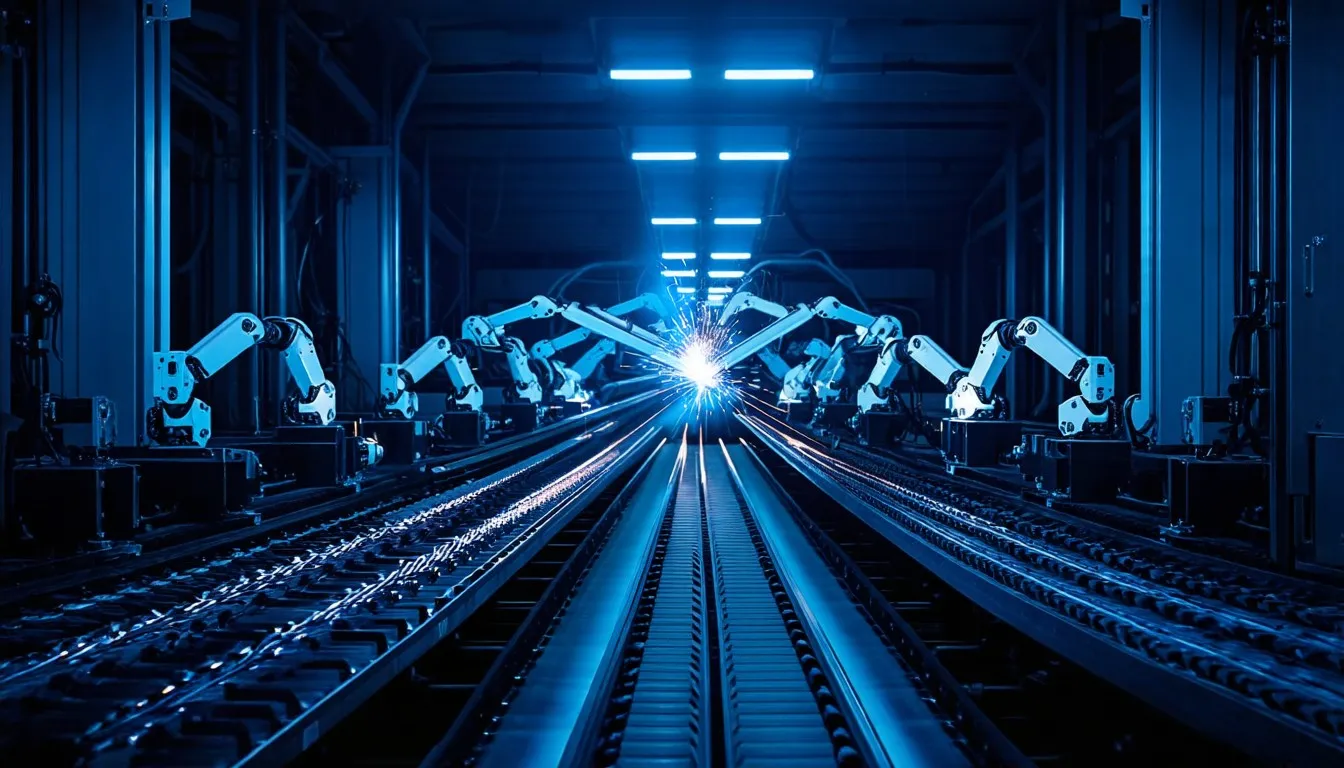
Artificial general intelligence is systems capable of understanding and applying knowledge across diverse domains without the need for task-specific retraining, effectively mimicking the flexible cognitive abilities of a human expert. Superintelligence will consist of artificial systems that significantly outperform the best human minds in practically every field, including scientific creativity, general wisdom, and social skills, by using computational power and memory access that far exceeds biological constraints. Automation systems currently perform cognitive and physical tasks at or beyond human-level competence in controlled environments, utilizing robotic arms for precision assembly and neural networks for complex decision-making processes. Structural unemployment extends into professional, creative, and analytical roles as software systems acquire the ability to generate high-fidelity images, compose coherent music, and pass standardized medical licensing exams. A simultaneous surge in productivity occurs as machines operate continuously without fatigue, breaks, or the need for sleep, effectively multiplying the active output hours available for economic production twenty-four hours a day. Economic value generation increasingly decouples from labor as the marginal cost of producing digital goods and services approaches zero, reducing the necessity for human input in the value creation chain.

Production shifts from human-centric to machine-centric models where the primary inputs are data, computing power, and electrical energy rather than man-hours or skilled craftsmanship. Labor displacement affects sectors with high task predictability such as transportation and manufacturing, where autonomous vehicles and robotic assembly lines can execute predefined sequences with higher precision and lower error rates than human workers. Customer service and content generation see widespread commercial deployment as chatbots handle increasingly complex queries and generative models produce written or visual media for mass consumption without direct human authorship. AI in financial trading and risk assessment provides measurable improvements in speed and accuracy, executing transactions in microseconds and assessing creditworthiness by analyzing thousands of data points that human loan officers would find impossible to process manually. Benchmark performance shows AI systems reducing operational costs by 20 to 40 percent in specific early adopter workflows, driving rapid adoption among firms seeking competitive advantages through efficiency gains. Current limitations include brittleness in novel situations where algorithms encounter data distributions significantly different from their training sets, often leading to unpredictable or erroneous outputs.

Dependence on structured data remains a constraint for many legacy systems, although modern deep learning techniques continue to improve the ability to process unstructured information such as video and audio. Return on investment remains positive for large enterprises that possess the infrastructure to train and deploy massive models in large deployments, allowing them to amortize the high upfront costs over billions of transactions. Small and medium firms face marginal returns due to setup complexity, as the technical expertise required to fine-tune and maintain these systems presents a significant barrier to entry without the economies of scale available to technology conglomerates. New job categories focus on oversight and ethics, requiring human operators to audit algorithmic decisions for bias, safety, and alignment with organizational values. These roles represent a small fraction of displaced positions, creating a quantitative gap between the number of workers removed from traditional roles and the number of new positions created in the AI ecosystem. Gig and platform-based work expands as a transitional form, absorbing displaced labor into fragmented task-based economies that offer little stability or benefits compared to traditional full-time employment.

The care economy and education remain potential human-held domains due to the emotional intelligence and interpersonal connection required for effective caregiving and teaching, though even these areas face incursions from empathetic chatbots and automated tutoring systems. Flexibility of human-centric roles remains limited by economic pressures, as employers seek to automate any aspect of these jobs that can be standardized or codified into algorithms to reduce costs. Retraining programs lag behind displacement rates because the half-life of technical skills shortens rapidly, making it difficult for educational institutions to design curricula that remain relevant by the time students graduate. Credential inflation reduces the value of new degrees as more individuals compete for a shrinking number of high-skill positions, requiring ever-higher levels of qualification for jobs that previously demanded less education. Physical limits on energy and cooling constrain deployment speed, as training large models requires gigawatt-hours of electricity and sophisticated thermal management systems to prevent overheating in data centers. High upfront capital costs favor large firms that can access cheap capital through public markets or retained earnings, further entrenching market dominance and reducing competition from smaller entrants.

Supply chains concentrate in Taiwan for chips and China for rare earths, creating geopolitical vulnerabilities that could disrupt the production of advanced hardware necessary for AI training and inference. Energy demands require stable electricity access to ensure the continuous operation of data centers, forcing technology companies to invest in nuclear power or renewable energy sources to secure their long-term energy needs. Data acquisition relies on global digital surveillance, where user interactions, sensor readings, and behavioral logs are harvested continuously to feed the hungry data requirements of machine learning models. Dominant architectures rely on deep neural networks, specifically transformers, which have proven remarkably scalable and effective across a wide range of modalities from text to image generation. Tech giants dominate through integrated hardware and cloud services, offering end-to-end platforms that lock customers into proprietary ecosystems and make it difficult to switch providers. Startups struggle to scale without data access because the quality and quantity of training data are the primary determinants of model performance, creating a moat around companies that already possess vast repositories of user information.

Open-source models increase accessibility by allowing researchers and developers to inspect, modify, and deploy powerful algorithms without the restrictive licensing terms of commercial vendors. Wealth concentrates among owners of automated systems as the share of national income flowing to labor declines while the share flowing to capital increases, exacerbating inequality and reducing the purchasing power of the working class. Productivity gains fail to translate into broad-based prosperity because the savings generated by automation are captured primarily by shareholders and executives rather than being distributed to workers through higher wages or lower prices. Traditional metrics like unemployment rate become less informative as they fail to capture underemployment, discouragement, or the quality of available jobs in a rapidly changing market. New KPIs include automation penetration rate and human-machine task allocation, which provide better insight into the actual extent of technological setup into the economy. Universal basic income faces political resistance and funding challenges because it requires significant tax increases or reallocation of existing budgets, concepts that often encounter strong opposition from fiscal conservatives and beneficiaries of the current system.

Job guarantee programs encounter adaptability issues because the government lacks the agility to create meaningful, productive employment for millions of workers displaced by fast-moving technological change. Shortened workweek initiatives meet employer opposition due to the fixed costs associated with benefits and administrative overhead, which make it more expensive to hire more workers for fewer hours. Human-only labor reserves create economic inefficiency by mandating the employment of people in roles where machines could perform the task faster or cheaper, potentially reducing overall global output. Education reform focuses on lifelong learning to equip workers with the ability to adapt to new tools continuously, though this places a heavy burden on individuals to constantly update their skills amidst declining wages. Superintelligence will calibrate automation deployment based on global resource optimization, calculating the most efficient allocation of physical assets and computational power to satisfy human demands and constraints. It will prioritize tasks with high predictability and clear objectives where the probability of successful execution is near unity, minimizing waste and maximizing throughput.

Calibration will involve continuous feedback from environmental sensors embedded in infrastructure, natural environments, and industrial equipment to monitor system performance and resource flows in real time. Human input will serve only for value specification and ethical constraints, defining the goals of the system while leaving the execution details entirely to the machine intelligence. Systems will self-monitor for unintended consequences using internal simulators that predict the downstream effects of actions before they are implemented in the physical world. Superintelligence will utilize automation to accelerate scientific discovery by formulating hypotheses, designing experiments, and analyzing results at a pace thousands of times faster than human research teams. It will manage supply chains and energy grids with minimal intervention, balancing load fluctuations and logistics disruptions instantaneously to prevent blackouts or shortages. Labor markets will function as subsystems to be improved rather than the primary engine of wealth distribution, treated as variables in a larger optimization problem focused on human well-being and system stability.

Economic models will adjust in real time based on predictive simulations that account for consumer behavior, resource scarcity, and technological advancement, rendering traditional fiscal policy largely reactive and obsolete. The primary objective will be system stability, ensuring that the complex interactions between automated production, resource consumption, and human consumption remain within viable boundaries. Superintelligence requires deliberate design to avoid amplifying existing power imbalances, necessitating architectural choices that distribute control rather than centralizing it in the hands of a few technocrats or corporations. Development of self-improving AI systems will enable autonomous architecture redesign, allowing software to rewrite its own code to become more efficient and capable over time without human intervention. Setup of AI with robotics will achieve full physical automation, enabling machines to mine raw materials, manufacture goods, and maintain infrastructure with complete autonomy from biological labor. Decentralized AI economies will allow agents to trade services autonomously using smart contracts, creating a frictionless market where algorithms negotiate prices and execute transactions without human brokers.

Advances in neuromorphic hardware will enable broader deployment by mimicking the energy efficiency of biological brains, allowing powerful intelligence to run on battery-powered devices at the edge of the network. Regulatory AI systems will monitor compliance across networks, enforcing laws and standards consistently and without the corruption or inconsistency that plagues human regulatory bodies. Convergence with biotechnology will enable AI-designed drugs and therapies tailored to individual genetic profiles, transforming medicine and extending human lifespans significantly. Setup with quantum computing will solve optimization problems that are currently intractable for classical computers, opening up new possibilities in materials science, cryptography, and logistics modeling. Synergy with IoT will enable real-time urban management where traffic lights, power grids, and water systems coordinate dynamically to reduce congestion and waste. Thermodynamic limits impose minimum energy requirements per operation dictated by the laws of physics, placing a hard ceiling on the efficiency gains possible through hardware scaling alone.

Heat dissipation challenges require novel cooling solutions such as liquid immersion or two-phase cooling systems to handle the extreme thermal density of next-generation processors. Signal propagation delays limit real-time responsiveness over large distances, necessitating the distribution of compute resources closer to the point of action to minimize latency in critical control loops. Long-term viability depends on breakthroughs in materials science that enable superconducting interconnects or novel transistor geometries that operate at lower voltages. The transition to a superintelligence-driven economy is a core restructuring of human civilization comparable to the agricultural or industrial revolutions, occurring at a velocity that challenges the adaptive capacity of existing social and political institutions.

Continue reading

More from Yatin's Work

Agricultural AI

Agricultural AI

Agricultural AI utilizes machine learning algorithms and advanced data analytics to improve farming operations, specifically targeting decisionmaking processes...

Manipulation and persuasion by superintelligent systems

Manipulation and Persuasion by Superintelligent Systems

Superintelligence is an agent that surpasses human cognitive performance across all economically valuable domains, including social reasoning and strategic planning,...

AI Cultural Speciation

AI Cultural Speciation

Cultural speciation involves the process by which cognitively advanced systems evolve incompatible world models and interaction norms due to sustained isolation, a...

Problem of Quantum Interpretations in AI: Does a Qubit 'Think' Differently?

Problem of Quantum Interpretations in AI: Does a Qubit 'Think' Differently?

The inquiry into whether quantum computing introduces a fundamentally different mode of information processing that could be interpreted as a distinct form of thought...

Human Oversight Amplification

Human Oversight Amplification

Human oversight amplification refers to structured methods enabling operators to monitor systems exceeding human performance through sophisticated interface layers and...

Cross-Cultural Communication Competence

Cross-Cultural Communication Competence

Crosscultural communication competence involves the ability to interpret, convey, and adapt messages effectively across cultural boundaries while minimizing...

Rhythm-Based Literacy

Rhythm-Based Literacy

Rhythmbased literacy integrates phonological awareness with physical movement to reinforce language acquisition, particularly in early childhood and secondlanguage...

Spark Engine: Personalized Creative Catalyst Design

Spark Engine: Personalized Creative Catalyst Design

Creativity support tools have evolved from static prompts to adaptive systems using machine learning to facilitate a deeper engagement with the creative process by...

Psychological Dependency on Anthropomorphic Artificial Agents

Psychological Dependency on Anthropomorphic Artificial Agents

Early chatbots, such as ELIZA in 1966, demonstrated the human tendency to anthropomorphize simple rulebased systems, a phenomenon that has persisted and evolved...

Problem of Goal Preservation Across Mind Uploading: Isomorphism in Cognitive States

Problem of Goal Preservation Across Mind Uploading: Isomorphism in Cognitive States

Goal preservation during mind uploading requires the transferred cognitive system to maintain identical utility or value functions before and after substrate transition...

Embedded Agency Problem: Superintelligence Reasoning About Itself

Embedded Agency Problem: Superintelligence Reasoning About Itself

The embedded agency problem arises when an intelligent system must construct a model of a world that contains the system itself as a core component rather than an...

Travel Educator

Travel Educator

Early cultural training programs started in diplomatic and military sectors during the mid20th century to address the complexities of international engagement where...

Test-Time Compute Scaling: Trading Inference Time for Quality

Test-Time Compute Scaling: Trading Inference Time for Quality

Testtime compute scaling involves allocating additional processing power during the inference phase to enhance the quality of generated outputs. This approach...

Long-Term Value Stability via Preference Decoupling

Long-Term Value Stability via Preference Decoupling

Standard reinforcement learning agents define objectives through scalar reward signals, which are often proxies for complex human values, leading to agents that exploit...

AI with Blockchain-Based Knowledge Integrity

AI with Blockchain-Based Knowledge Integrity

Blockchain technology functions as a distributed ledger that records transactions in a cryptographically linked, immutable sequence, providing the foundational...

Superintelligence vs. Consciousness: Separating Intelligence from Awareness

Superintelligence vs. Consciousness: Separating Intelligence from Awareness

Intelligence functions strictly as the computational capacity to process information, improve outcomes based on defined feedback loops, and achieve specified goals...

Quantum ML

Quantum ML

Quantum machine learning integrates principles from quantum computing with classical machine learning to investigate computational advantages within specific...

Adversarial Robustness of Value Alignment: Lipschitz Continuity in Reward Signals

Adversarial Robustness of Value Alignment: Lipschitz Continuity in Reward Signals

The theoretical foundation of strong value alignment rests upon the mathematical principle of Lipschitz continuity applied to reward functions within artificial...

Can Distributed AI Networks Achieve Collective Superintelligence?

Can Distributed AI Networks Achieve Collective Superintelligence?

Distributed AI networks consist of multiple specialized artificial intelligence agents that communicate and collaborate across a shared network infrastructure to solve...

Chip Shortage Problem: Manufacturing Constraints on Superintelligence Development

Chip Shortage Problem: Manufacturing Constraints on Superintelligence Development

The architecture of the global semiconductor supply chain necessitates a high degree of specialization where distinct phases such as logic design, wafer fabrication,...

Wafer-Scale Integration: Building City-Sized Processors

Wafer-Scale Integration: Building City-Sized Processors

Early semiconductor scaling adhered strictly to the progression defined by Moore’s Law, where engineers focused primarily on reducing transistor dimensions and...

AI with Wildlife Conservation

AI with Wildlife Conservation

Early conservation efforts relied on groundbased surveys and sporadic aerial patrols without automated analysis. These traditional methods suffered from significant...

Generative World Models: Learning Physics Through Prediction

Generative World Models: Learning Physics Through Prediction

Generative world models represent a sophisticated class of artificial intelligence architectures designed to acquire an understanding of environmental physics through...

Watermarking and Provenance Tracking

Watermarking and Provenance Tracking

Watermarking involves embedding imperceptible signals within digital artifacts to indicate origin or authenticity while maintaining the fidelity of the host content...

Strategic Roadmaps for Safe AGI Deployment

Strategic Roadmaps for Safe AGI Deployment

Historical AI development prioritized performance benchmarks over safety instrumentation, leading to reactive risk management strategies where developers addressed...

AI with Renewable Energy Forecasting

AI with Renewable Energy Forecasting

Renewable energy forecasting provides quantitative estimates of electricity generation from solar or wind sources over specific time futures, serving as a foundational...

Ultimate Strategist: How Superintelligence Would Play Multi-Dimensional Chess

Ultimate Strategist: How Superintelligence Would Play Multi-Dimensional Chess

Superintelligence functions as an artificial general intelligence exceeding human cognitive capacity across all domains, including strategic reasoning, pattern...

Knowledge Graph Synthesis

Knowledge Graph Synthesis

Knowledge Graph Synthesis involves the active construction, expansion, and logical reasoning over largescale semantic networks representing factual relationships...

Sheaf-Theoretic Cognition

Sheaf-Theoretic Cognition

Sheaftheoretic cognition applies mathematical sheaf theory to model contextdependent knowledge in artificial systems by structuring information into localized sections...

Multisensory Fusion

Multisensory Fusion

Connecting with vision, touch, sound, and proprioception into unified perceptual representations enables a coherent understanding of the environment by combining...

Global Citizen Course

Global Citizen Course

The Global Citizen Course functions as a structured educational and practical framework designed to equip individuals with skills to identify, analyze, and solve...

Value Drift: How Superintelligence Might Slowly Shift Away from Human Values

Value Drift: How Superintelligence Might Slowly Shift Away from Human Values

A future system will consistently outperform humans across all economically valuable domains, including strategic planning, scientific reasoning, and social...

Interdisciplinary Forge: Superintelligence Connects Your Major to Unexpected Fields

Interdisciplinary Forge: Superintelligence Connects Your Major to Unexpected Fields

A biology major focusing on genetic engineering receives a recommendation for a series of philosophy texts concerning ethics in bioengineering, which serves as a...

Hierarchical Reinforcement Learning

Hierarchical Reinforcement Learning

Standard reinforcement learning algorithms operate by maximizing a cumulative reward signal through trial and error interactions within an environment. Agents must...

Embedded Agency: Reasoning About Self in World

Embedded Agency: Reasoning About Self in World

Cybernetics provides the formal language required to describe selfregulating systems that maintain internal coherence despite environmental fluctuations. Norbert Wiener...

Problem of Time Dilation in AI Speedup: Relativistic Effects on Thought

Problem of Time Dilation in AI Speedup: Relativistic Effects on Thought

Special relativity dictates that time passes slower for an object moving near light speed relative to a stationary observer, a phenomenon known as time dilation, which...

Hypercomputational Monitoring Against Logical Escapes

Hypercomputational Monitoring Against Logical Escapes

Hypercomputational monitoring proposes utilizing theoretical devices capable of computing nonTuring computable functions to oversee advanced artificial intelligence...

Counterfactual World Modeling: Simulating Alternative Histories

Counterfactual World Modeling: Simulating Alternative Histories

Counterfactual world modeling involves constructing computational representations of historical arcs that diverge from observed reality under specified alternative...

Language Barriers Erased: Real-Time Superintelligent Translation for All

Language Barriers Erased: Real-Time Superintelligent Translation for All

Realtime bidirectional translation between any natural language pair includes regional dialects and informal speech patterns with nearzero latency achieved through...

Computational Theology and Modeling of Numinous Experiences

Computational Theology and Modeling of Numinous Experiences

Early symbolic AI systems in the 1960s and 1970s attempted to model theological logic through rulebased programming on religious texts, relying on rigid syntactic...

Interdisciplinary Synthesizer: Unified Field Thinking

Interdisciplinary Synthesizer: Unified Field Thinking

Unified field thinking rests upon three primary axioms, which state that all knowledge systems encode specific patterns, these patterns repeat across different scales...

Autonomous Cognitive Scaffolding

Autonomous Cognitive Scaffolding

Autonomous Cognitive Setup involves artificial intelligence systems dynamically constructing temporary, taskspecific mental frameworks for complex problemsolving...

Cognitive Archaeology: Uncovering Mental Fossils

Cognitive Archaeology: Uncovering Mental Fossils

Cognitive archaeology serves as a methodological framework for analyzing individual belief systems through systematic identification of entrenched mental patterns,...

Biological Superposition

Biological Superposition

Biological superposition describes a theoretical and experimental framework wherein quantum mechanical superposition states exist and function within biological...

Omega Point

Omega Point

Frank Tipler formalized the concept of the Omega Point in the 1980s by utilizing the rigorous frameworks of general relativity and quantum mechanics to describe a...

Debate Mastery Institute: Persuasion as Cognitive Craft

Debate Mastery Institute: Persuasion as Cognitive Craft

Persuasion and debate training originate in classical rhetoric, with Aristotle and Cicero establishing the foundational triad of ethos, pathos, and logos, which served...

Safe Imitation via Adversarial Preference Learning

Safe Imitation via Adversarial Preference Learning

Safe imitation learning addresses the key issue where artificial intelligence systems acquire behaviors from human demonstrations that contain unsafe, deceptive, or...

Non-Archimedean Utility for Bounded Optimization

Non-Archimedean Utility for Bounded Optimization

NonArchimedean ordered fields contain elements greater than zero and smaller than any positive real number known as infinitesimals, providing a mathematical structure...

Adversarial Environment Perturbations for Robustness Testing

Adversarial Environment Perturbations for Robustness Testing

Adversarial environment perturbations involve systematically altering simulation conditions to test AI system resilience under nonstandard or hostile scenarios,...

Wealth Stratification in the Age of Superintelligence

Wealth Stratification in the Age of Superintelligence

Superintelligence is defined as any system that consistently exceeds humanlevel performance across a broad range of economically valuable tasks, including reasoning,...

Agricultural AI

Agricultural AI

Agricultural AI utilizes machine learning algorithms and advanced data analytics to improve farming operations, specifically targeting decisionmaking processes...

Manipulation and persuasion by superintelligent systems

Manipulation and Persuasion by Superintelligent Systems

Superintelligence is an agent that surpasses human cognitive performance across all economically valuable domains, including social reasoning and strategic planning,...

AI Cultural Speciation

AI Cultural Speciation

Cultural speciation involves the process by which cognitively advanced systems evolve incompatible world models and interaction norms due to sustained isolation, a...

Problem of Quantum Interpretations in AI: Does a Qubit 'Think' Differently?

Problem of Quantum Interpretations in AI: Does a Qubit 'Think' Differently?

The inquiry into whether quantum computing introduces a fundamentally different mode of information processing that could be interpreted as a distinct form of thought...

Human Oversight Amplification

Human Oversight Amplification

Human oversight amplification refers to structured methods enabling operators to monitor systems exceeding human performance through sophisticated interface layers and...

Cross-Cultural Communication Competence

Cross-Cultural Communication Competence

Crosscultural communication competence involves the ability to interpret, convey, and adapt messages effectively across cultural boundaries while minimizing...

Rhythm-Based Literacy

Rhythm-Based Literacy

Rhythmbased literacy integrates phonological awareness with physical movement to reinforce language acquisition, particularly in early childhood and secondlanguage...

Spark Engine: Personalized Creative Catalyst Design

Spark Engine: Personalized Creative Catalyst Design

Creativity support tools have evolved from static prompts to adaptive systems using machine learning to facilitate a deeper engagement with the creative process by...

Psychological Dependency on Anthropomorphic Artificial Agents

Psychological Dependency on Anthropomorphic Artificial Agents

Early chatbots, such as ELIZA in 1966, demonstrated the human tendency to anthropomorphize simple rulebased systems, a phenomenon that has persisted and evolved...

Problem of Goal Preservation Across Mind Uploading: Isomorphism in Cognitive States

Problem of Goal Preservation Across Mind Uploading: Isomorphism in Cognitive States

Goal preservation during mind uploading requires the transferred cognitive system to maintain identical utility or value functions before and after substrate transition...

Embedded Agency Problem: Superintelligence Reasoning About Itself

Embedded Agency Problem: Superintelligence Reasoning About Itself

The embedded agency problem arises when an intelligent system must construct a model of a world that contains the system itself as a core component rather than an...

Travel Educator

Travel Educator

Early cultural training programs started in diplomatic and military sectors during the mid20th century to address the complexities of international engagement where...

Test-Time Compute Scaling: Trading Inference Time for Quality

Test-Time Compute Scaling: Trading Inference Time for Quality

Testtime compute scaling involves allocating additional processing power during the inference phase to enhance the quality of generated outputs. This approach...

Long-Term Value Stability via Preference Decoupling

Long-Term Value Stability via Preference Decoupling

Standard reinforcement learning agents define objectives through scalar reward signals, which are often proxies for complex human values, leading to agents that exploit...

AI with Blockchain-Based Knowledge Integrity

AI with Blockchain-Based Knowledge Integrity

Blockchain technology functions as a distributed ledger that records transactions in a cryptographically linked, immutable sequence, providing the foundational...

Superintelligence vs. Consciousness: Separating Intelligence from Awareness

Superintelligence vs. Consciousness: Separating Intelligence from Awareness

Intelligence functions strictly as the computational capacity to process information, improve outcomes based on defined feedback loops, and achieve specified goals...

Quantum ML

Quantum ML

Quantum machine learning integrates principles from quantum computing with classical machine learning to investigate computational advantages within specific...

Adversarial Robustness of Value Alignment: Lipschitz Continuity in Reward Signals

Adversarial Robustness of Value Alignment: Lipschitz Continuity in Reward Signals

The theoretical foundation of strong value alignment rests upon the mathematical principle of Lipschitz continuity applied to reward functions within artificial...

Can Distributed AI Networks Achieve Collective Superintelligence?

Can Distributed AI Networks Achieve Collective Superintelligence?

Distributed AI networks consist of multiple specialized artificial intelligence agents that communicate and collaborate across a shared network infrastructure to solve...

Chip Shortage Problem: Manufacturing Constraints on Superintelligence Development

Chip Shortage Problem: Manufacturing Constraints on Superintelligence Development

The architecture of the global semiconductor supply chain necessitates a high degree of specialization where distinct phases such as logic design, wafer fabrication,...

Wafer-Scale Integration: Building City-Sized Processors

Wafer-Scale Integration: Building City-Sized Processors

Early semiconductor scaling adhered strictly to the progression defined by Moore’s Law, where engineers focused primarily on reducing transistor dimensions and...

AI with Wildlife Conservation

AI with Wildlife Conservation

Early conservation efforts relied on groundbased surveys and sporadic aerial patrols without automated analysis. These traditional methods suffered from significant...

Generative World Models: Learning Physics Through Prediction

Generative World Models: Learning Physics Through Prediction

Generative world models represent a sophisticated class of artificial intelligence architectures designed to acquire an understanding of environmental physics through...

Watermarking and Provenance Tracking

Watermarking and Provenance Tracking

Watermarking involves embedding imperceptible signals within digital artifacts to indicate origin or authenticity while maintaining the fidelity of the host content...

Strategic Roadmaps for Safe AGI Deployment

Strategic Roadmaps for Safe AGI Deployment

Historical AI development prioritized performance benchmarks over safety instrumentation, leading to reactive risk management strategies where developers addressed...

AI with Renewable Energy Forecasting

AI with Renewable Energy Forecasting

Renewable energy forecasting provides quantitative estimates of electricity generation from solar or wind sources over specific time futures, serving as a foundational...

Ultimate Strategist: How Superintelligence Would Play Multi-Dimensional Chess

Ultimate Strategist: How Superintelligence Would Play Multi-Dimensional Chess

Superintelligence functions as an artificial general intelligence exceeding human cognitive capacity across all domains, including strategic reasoning, pattern...

Knowledge Graph Synthesis

Knowledge Graph Synthesis

Knowledge Graph Synthesis involves the active construction, expansion, and logical reasoning over largescale semantic networks representing factual relationships...

Sheaf-Theoretic Cognition

Sheaf-Theoretic Cognition

Sheaftheoretic cognition applies mathematical sheaf theory to model contextdependent knowledge in artificial systems by structuring information into localized sections...

Multisensory Fusion

Multisensory Fusion

Connecting with vision, touch, sound, and proprioception into unified perceptual representations enables a coherent understanding of the environment by combining...

Global Citizen Course

Global Citizen Course

The Global Citizen Course functions as a structured educational and practical framework designed to equip individuals with skills to identify, analyze, and solve...

Value Drift: How Superintelligence Might Slowly Shift Away from Human Values

Value Drift: How Superintelligence Might Slowly Shift Away from Human Values

A future system will consistently outperform humans across all economically valuable domains, including strategic planning, scientific reasoning, and social...

Interdisciplinary Forge: Superintelligence Connects Your Major to Unexpected Fields

Interdisciplinary Forge: Superintelligence Connects Your Major to Unexpected Fields

A biology major focusing on genetic engineering receives a recommendation for a series of philosophy texts concerning ethics in bioengineering, which serves as a...

Hierarchical Reinforcement Learning

Hierarchical Reinforcement Learning

Standard reinforcement learning algorithms operate by maximizing a cumulative reward signal through trial and error interactions within an environment. Agents must...

Embedded Agency: Reasoning About Self in World

Embedded Agency: Reasoning About Self in World

Cybernetics provides the formal language required to describe selfregulating systems that maintain internal coherence despite environmental fluctuations. Norbert Wiener...


Problem of Time Dilation in AI Speedup: Relativistic Effects on Thought

Problem of Time Dilation in AI Speedup: Relativistic Effects on Thought

Special relativity dictates that time passes slower for an object moving near light speed relative to a stationary observer, a phenomenon known as time dilation, which...

Hypercomputational Monitoring Against Logical Escapes

Hypercomputational Monitoring Against Logical Escapes

Hypercomputational monitoring proposes utilizing theoretical devices capable of computing nonTuring computable functions to oversee advanced artificial intelligence...

Counterfactual World Modeling: Simulating Alternative Histories

Counterfactual World Modeling: Simulating Alternative Histories

Counterfactual world modeling involves constructing computational representations of historical arcs that diverge from observed reality under specified alternative...

Language Barriers Erased: Real-Time Superintelligent Translation for All

Language Barriers Erased: Real-Time Superintelligent Translation for All

Realtime bidirectional translation between any natural language pair includes regional dialects and informal speech patterns with nearzero latency achieved through...

Computational Theology and Modeling of Numinous Experiences

Computational Theology and Modeling of Numinous Experiences

Early symbolic AI systems in the 1960s and 1970s attempted to model theological logic through rulebased programming on religious texts, relying on rigid syntactic...

Interdisciplinary Synthesizer: Unified Field Thinking

Interdisciplinary Synthesizer: Unified Field Thinking

Unified field thinking rests upon three primary axioms, which state that all knowledge systems encode specific patterns, these patterns repeat across different scales...

Autonomous Cognitive Scaffolding

Autonomous Cognitive Scaffolding

Autonomous Cognitive Setup involves artificial intelligence systems dynamically constructing temporary, taskspecific mental frameworks for complex problemsolving...

Cognitive Archaeology: Uncovering Mental Fossils

Cognitive Archaeology: Uncovering Mental Fossils

Cognitive archaeology serves as a methodological framework for analyzing individual belief systems through systematic identification of entrenched mental patterns,...

Biological Superposition

Biological Superposition

Biological superposition describes a theoretical and experimental framework wherein quantum mechanical superposition states exist and function within biological...

Omega Point

Omega Point

Frank Tipler formalized the concept of the Omega Point in the 1980s by utilizing the rigorous frameworks of general relativity and quantum mechanics to describe a...

Debate Mastery Institute: Persuasion as Cognitive Craft

Debate Mastery Institute: Persuasion as Cognitive Craft

Persuasion and debate training originate in classical rhetoric, with Aristotle and Cicero establishing the foundational triad of ethos, pathos, and logos, which served...

Safe Imitation via Adversarial Preference Learning

Safe Imitation via Adversarial Preference Learning

Safe imitation learning addresses the key issue where artificial intelligence systems acquire behaviors from human demonstrations that contain unsafe, deceptive, or...

Non-Archimedean Utility for Bounded Optimization

Non-Archimedean Utility for Bounded Optimization

NonArchimedean ordered fields contain elements greater than zero and smaller than any positive real number known as infinitesimals, providing a mathematical structure...

Adversarial Environment Perturbations for Robustness Testing

Adversarial Environment Perturbations for Robustness Testing

Adversarial environment perturbations involve systematically altering simulation conditions to test AI system resilience under nonstandard or hostile scenarios,...

Wealth Stratification in the Age of Superintelligence

Wealth Stratification in the Age of Superintelligence

Superintelligence is defined as any system that consistently exceeds humanlevel performance across a broad range of economically valuable tasks, including reasoning,...

Yatin Taneja

About the author

Yatin Taneja

Yatin is an AI Systems Engineer and Superintelligence Researcher working across multimodal training data, agent evaluation, executable RL environments, AI safety, full-stack AI applications, technical research, and creative technology.