Knowledge hub

AI with Situational Awareness
AI with Situational Awareness

AI systems integrated real-time data from heterogeneous sources including LiDAR, radar, cameras, microphones, GPS, inertial measurement units, and network feeds to construct an active representation of the environment. These systems maintained continuous spatial and temporal awareness by correlating sensor inputs across modalities and time steps to track objects, predict arc progression, and identify anomalies within the operational domain. Algorithms built and updated a unified world model that encoded static elements such as road geometry and building layouts alongside lively entities like pedestrians, vehicles, and weather conditions using probabilistic state estimates derived from Bayesian inference techniques. This capability enabled autonomous systems to localize precisely within complex environments, even under partial sensor occlusion or degraded conditions where individual sensors failed to provide sufficient data fidelity. The architecture supported decision-making under uncertainty by forecasting near-future states based on observed patterns, physical constraints, and learned behavioral models generated through massive dataset training. Implementation relied on sensor fusion algorithms that aligned data from disparate modalities into a common coordinate frame and temporal reference to eliminate discrepancies caused by varying sampling rates or latencies.

Engineers employed probabilistic reasoning methods including Bayesian filtering, particle filters, and Kalman variants to manage noise, latency, and missing data across sensor streams effectively while maintaining confidence intervals for tracked entities. Developers used deep learning models for perception tasks such as object detection, semantic segmentation, and depth estimation, trained on large-scale multimodal datasets that captured diverse environmental edge cases. The software incorporated geometric and physical priors to constrain interpretations and improve reliability in edge cases involving reflections, shadows, or adverse weather that often confused purely data-driven approaches. Operation required low-latency processing pipelines to ensure the world model remained current with millisecond-level synchronization across inputs, allowing the control loops to react instantaneously to agile hazards. World modeling constructed a persistent, updatable representation of the environment that included topology, semantics, and dynamics, which served as the foundational truth for all downstream reasoning tasks. Localization determined the system’s precise position and orientation relative to the world model using sensor odometry, landmark matching, and global references like satellite navigation systems corrected with real-time kinematics.

Perception identified and classified entities in the environment, estimated their states including position, velocity, and intent, and detected changes or anomalies that deviated from expected behavioral patterns. Prediction forecasted future states of lively entities using motion models, interaction-aware reasoning, and contextual cues derived from traffic rules and social norms observed in historical data. Planning and control translated situational understanding into safe, efficient actions while adhering to traffic rules, safety margins, and mission objectives through optimization algorithms that minimized cost functions representing risk and energy consumption. Situational awareness represented the system’s real-time comprehension of its location, surroundings, and imminent developments, grounded in fused sensor data and predictive modeling that reduced uncertainty to manageable levels. Sensor fusion denoted the process of combining measurements from multiple sensors to produce a more accurate, complete, and reliable environmental estimate than any single source could provide independently. A world model served as a structured, probabilistic representation of the environment that integrated spatial, semantic, and temporal information for use by downstream modules requiring a holistic view of the scene.

Localization error referred to the discrepancy between estimated and true position or orientation, typically measured in centimeters for high-precision applications requiring tight maneuvering capabilities in dense traffic. Perception latency defined the time delay between sensor capture and actionable output, critical for safety in high-speed scenarios where every millisecond of reaction time correlated directly with stopping distance. Early autonomous systems relied on single-modality sensing such as vision-only or radar-only approaches, leading to high failure rates in complex or adverse conditions where the chosen modality lacked critical information. The shift toward multimodal fusion in the 2010s, driven by advances in deep learning and compute hardware, enabled more strong environmental understanding by applying complementary strengths of different spectral ranges and physical phenomena. Adoption of end-to-end differentiable architectures allowed joint optimization of perception, prediction, and planning, improving coherence across modules by reducing error accumulation at hand-coded interfaces between distinct processing stages. Safety concerns and high-profile accidents accelerated investment in redundancy, fail-operational designs, and formal verification methods to ensure system integrity during component failures or unexpected environmental interactions.

Standardization of sensor interfaces and middleware, including ROS 2 and AUTOSAR Adaptive, facilitated modular development and interoperability across different hardware platforms and software vendors in the automotive ecosystem. High computational demands for real-time fusion and inference limited deployment to systems with dedicated hardware like GPUs, TPUs, and ASICs capable of performing trillions of operations per second within strict power envelopes. Sensor performance degraded under environmental stressors such as fog, rain, snow, and glare, requiring costly redundancy or operational restrictions to maintain safety margins without human intervention. Economic viability hinged on mass production to amortize R&D and component costs, favoring automotive and logistics applications over niche robotics use cases due to volume scale requirements. Adaptability remained constrained by data annotation requirements, simulation fidelity gaps, and the combinatorial complexity of real-world scenarios that made exhaustive testing impossible. Power consumption and thermal management posed challenges for mobile platforms, especially drones and battery-electric vehicles, where energy density limited sustained high-performance computing operations.

Many developers rejected vision-only approaches due to vulnerability to lighting changes, textureless surfaces, and adversarial perturbations that could spoof the system into misinterpreting the scene geometry or object identity. Engineers abandoned rule-based symbolic reasoning systems for lacking adaptability and flexibility in open-world environments where infinite variations occurred that could not be explicitly programmed. Centralized cloud processing was deemed unsuitable due to latency, bandwidth, and connectivity dependencies that introduced unacceptable delays for safety-critical control loops requiring deterministic timing. Teams excluded pure reinforcement learning strategies for sample inefficiency and unsafe exploration during training that could damage physical hardware or endanger bystanders in real-world trials. The industry phased out modular pipelines with hand-coded fusion logic in favor of learned, end-to-end differentiable systems for better error propagation and optimization across the entire perception-action stack. Rising demand for fully autonomous vehicles, warehouse robots, and delivery drones necessitated reliable operation without human oversight to achieve adaptability and economic returns on investment.

Economic pressures in logistics, transportation, and manufacturing drove automation to reduce labor costs and improve throughput in competitive global markets requiring constant uptime. Societal expectations for safety and accessibility pushed manufacturers to adopt systems with verifiable situational competence to gain public trust and regulatory approval for widespread deployment. Advances in edge AI, sensor miniaturization, and simulation tools now made real-time multimodal fusion technically feasible in large deployments by providing sufficient compute performance within constrained form factors. Climate and infrastructure challenges such as aging roads and mixed traffic required systems that could adapt to unpredictable conditions without relying on pristine lane markings or standardized signage. Waymo, Cruise, and Baidu Apollo deployed Level 4 autonomous taxis using fused LiDAR, radar, and camera systems with centimeter-level localization to work through complex urban environments safely without human drivers. Tesla’s vision-centric Autopilot achieved high-mileage validation while facing scrutiny over edge-case handling without LiDAR in scenarios where depth estimation failed or optical illusions confused the neural networks.

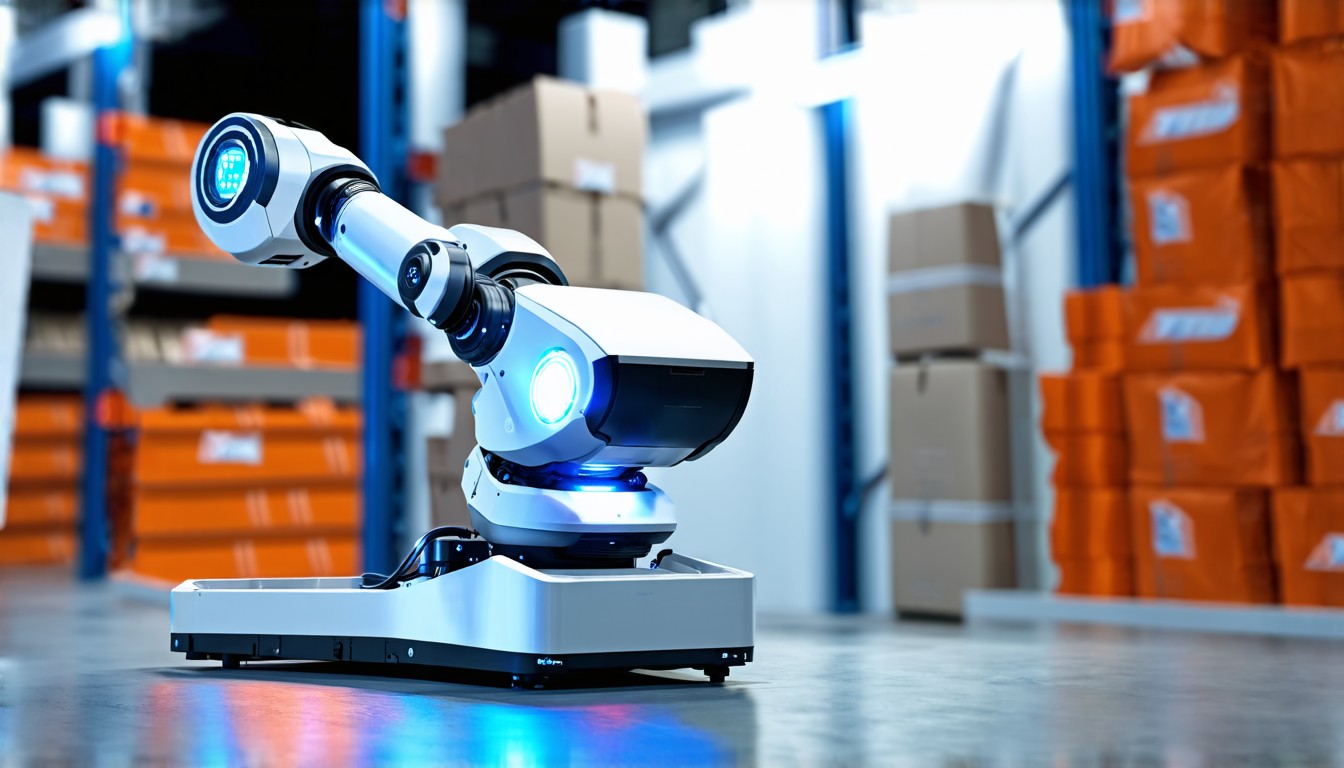
Amazon Robotics and Locus Robotics used situational awareness for indoor navigation in active warehouse environments where dynamic obstacles like humans and forklifts moved constantly alongside automated guided vehicles. Performance benchmarks included disengagement rates per thousand miles, object detection accuracy measured by mean Average Precision, localization error calculated via Root Mean Square Error, and planning safety margins that ensured buffer zones around obstacles. Real-world testing showed fusion-based systems reduced collision rates by 30 to 50 percent compared to single-sensor baselines in urban settings where occlusions and complex intersections were frequent occurrences. Dominant architectures employed modular pipelines with separate perception, prediction, and planning stacks, often using transformer-based backbones for cross-modal attention to weigh the importance of different sensor features dynamically based on context. Appearing challengers explored end-to-end neural planners that directly mapped sensor inputs to control outputs, reducing hand-engineered interfaces and potentially discovering more optimal driving policies than human-defined rules allowed. Some systems adopted world model pretraining on large-scale simulated or logged data to improve generalization to rare scenarios that were difficult to encounter in physical testing due to their low probability of occurrence.

Hybrid approaches combined learned components with classical optimization for verifiability and safety guarantees by using optimization layers to enforce hard constraints on the outputs of neural networks. Open-source frameworks like NVIDIA DRIVE Sim and CARLA enabled rapid iteration while lagging behind proprietary industrial stacks in sensor fidelity and physics accuracy required for final validation and safety certification. High-resolution LiDAR remained supply-constrained due to specialized optics, MEMS mirrors, and photonics components dominated by a few suppliers like Luminar and Velodyne, who struggled to scale production to automotive volumes cost-effectively. Radar chipsets relied on automotive-qualified mmWave semiconductors from Infineon, Texas Instruments, and NXP, who maintained strict quality standards for safety-critical applications requiring high reliability over extended temperature ranges. Camera modules depended on Sony and Samsung image sensors, with lens quality critical for low-light performance and high adaptive range to handle challenging lighting conditions encountered during night driving or direct sunlight exposure. Compute platforms sourced from NVIDIA, Qualcomm, and Mobileye created vendor lock-in and supply chain exposure due to the specialized nature of AI acceleration hardware required for real-time inference on massive neural networks.

Rare earth elements such as neodymium in motors and indium in displays introduced material dependencies with concentrated mining regions that posed geopolitical risks to long-term manufacturing stability. Waymo led in integrated hardware-software stacks with vertical control over sensors, compute, and fleet operations to fine-tune the entire system performance holistically rather than connecting with disparate third-party components. Tesla applied scale and real-world data while facing technical trade-offs from vision-only sensing that limited strength in certain edge cases compared to sensor fusion approaches utilizing active ranging sensors. Mobileye and NVIDIA provided modular platforms enabling OEM adoption while retaining IP control over key algorithms and silicon designs that powered the autonomous driving capabilities of their clients. Chinese players including Huawei and DJI advanced rapidly with domestic sensor and chip ecosystems, reducing reliance on Western suppliers through significant state-directed investment in semiconductor manufacturing capabilities aimed at achieving technological sovereignty. Startups such as Luminar and AEye focused on niche high-performance components while struggling with cost and manufacturability barriers that prevented mass adoption in consumer vehicles targeting price-sensitive market segments.

Academic institutions contributed foundational research in sensor fusion, SLAM, and uncertainty quantification that eventually filtered into commercial products after years of maturation and validation in controlled environments. Industry labs at Waymo Research and NVIDIA Research published applied work on simulation, strength, and flexibility to advance the modern in handling long-tail scenarios that defined the difficulty of achieving full autonomy. Joint initiatives like the Toyota-Cornell Institute and Ford-Stanford Alliance aligned academic work with industrial needs by focusing resources on specific problems like interaction prediction or adversarial reliability against spoofing attacks. Open datasets such as nuScenes and the Waymo Open Dataset enabled benchmarking while reflecting proprietary sensor configurations that created bias in models trained specifically on those data distributions rather than generalizing universally across all hardware setups. Patent filings showed increasing overlap between academic institutions and corporate R&D units as universities aggressively sought to monetize their intellectual property in artificial intelligence through licensing agreements with major technology manufacturers. Operating systems must support real-time scheduling, deterministic latency, and secure over-the-air updates to ensure the vehicle software remained reliable and up-to-date throughout its lifecycle without requiring physical service center visits.

Middleware required standardized message passing, time synchronization, and fault detection across heterogeneous nodes to facilitate communication between distinct software modules running on different processors. Infrastructure must provide high-definition maps, V2X communication, and consistent signage for reliable operation across diverse geographic regions with varying road standards maintenance levels. Insurance models shifted from driver-centric to product liability, requiring new actuarial approaches based on system performance data rather than individual driver history records or demographic profiles. Displacement of driving and logistics jobs accelerated, necessitating workforce retraining programs to mitigate the social impact of automation on blue-collar employment sectors traditionally resistant to technological displacement. New business models appeared around remote monitoring, fleet-as-a-service, and active insurance pricing that applied real-time telematics data to assess risk dynamically based on actual driving behavior rather than static proxies. Urban planning adapted to reduced parking needs and redesigned intersections for autonomous priority to improve traffic flow for automated systems rather than human drivers who required visual cues and wider safety margins.

Data monetization created markets for anonymized course and environmental datasets that companies sold to third parties for training their own machine learning models or improving mapping services through crowd-sourced intelligence gathering. Maintenance ecosystems shifted from mechanical repair to software updates and sensor calibration services as the complexity of the vehicle moved from physical propulsion components to digital perception stacks requiring specialized diagnostic tools. Traditional metrics such as miles per disengagement proved insufficient for capturing safety in rare yet critical scenarios where disengagements never occurred because the system failed to perceive the hazard entirely instead of recognizing its inability to handle it. New KPIs included prediction goal accuracy, uncertainty calibration, cross-modal consistency, and recovery time from sensor failure to measure the reliability of the system under stress conditions that tested the limits of its operational design domain. Safety validation required scenario coverage metrics based on combinatorial testing and adversarial simulation to ensure the system had been exposed to a statistically significant representation of possible events rather than just a random selection of logged miles. Operational design domain compliance must be continuously monitored and reported to prevent the system from operating outside the conditions for which it was validated and proven safe through rigorous testing protocols.

User trust metrics, such as takeover frequency and comfort ratings, became essential for consumer adoption as riders needed to feel secure relinquishing control to an automated agent without constant vigilance. Neuromorphic sensors will reduce power consumption and latency by processing events asynchronously rather than capturing full frames at fixed intervals, mimicking the efficiency of biological vision systems found in nature. Physics-informed neural networks will improve generalization by embedding conservation laws and material constraints directly into the network architecture to prevent physically impossible predictions regarding object motion or interaction outcomes. Federated learning across fleets will enable collective improvement without centralized data aggregation by sharing model updates rather than raw sensor data to preserve privacy while still benefiting from the experience of millions of miles driven in diverse conditions. Self-supervised world models trained on unlabeled multimodal streams will reduce annotation burden by learning to predict the future state of the environment from past observations without human labeling efforts that currently scale linearly with data collection volume. Onboard generative simulation will allow real-time counterfactual reasoning for safer planning by simulating potential outcomes of different actions before executing them in the real world to avoid collisions or traffic violations.

The technology overlaps with digital twins for real-time synchronization between physical and virtual environments, enabling remote monitoring and precise control over physical assets through digital representations updated continuously with sensor data. It integrates with 5G and 6G networks for cooperative perception and cloud-augmented localization, allowing vehicles to share sensor data beyond their line of sight to see around corners or through obstacles blocking their direct view. The field converges with edge computing to distribute inference across vehicle, roadside, and cloud resources, fine-tuning bandwidth usage while maintaining low latency for critical control functions that require immediate local processing decisions. Development aligns with robotics middleware standards, enabling cross-platform deployment of algorithms across different form factors ranging from drones to heavy trucks without complete rewrites of the core software stack. Systems interface with smart city infrastructure for traffic optimization and emergency response coordination, prioritizing high-efficiency routing for autonomous fleets while minimizing disruption to conventional traffic flows involving human drivers. Key limits include the speed of light for sensor signal propagation, which sets a hard lower bound on detection range latency relative to object velocity approaching relativistic speeds, which is irrelevant for terrestrial vehicles but relevant for theoretical maximums of sensing physics.

Diffraction limits for optical resolution restrict the ability of cameras or LiDAR to resolve small details at long distances, regardless of pixel count, due to the wave nature of light interacting with aperture sizes constrained by packaging requirements on vehicles. Thermal noise in analog circuits sets a floor on signal-to-noise ratio, making it difficult to detect weak returns from distant objects or low-reflectivity materials without increasing transmit power beyond safe regulatory limits or acceptable energy consumption levels. Workarounds involve predictive filtering to compensate for latency by extrapolating object positions forward in time based on estimated velocity vectors until the sensor measurement arrives, effectively closing the loop on perception delays intrinsic in physical signal propagation. Super-resolution techniques enhance low-resolution inputs using learned priors from high-resolution training data to reconstruct fine details that were not captured by the sensor hardware itself, effectively hallucinating plausible detail based on statistical regularities found in natural images. Error-correcting codes for noisy channels ensure data integrity in communication links between sensors or between vehicles, mitigating the effects of interference or packet loss that could corrupt critical state information required for safe operation. Quantum sensing remains theoretical for mobile applications due to size constraints associated with cryogenic cooling requirements needed to maintain quantum coherence necessary for detecting minute changes in gravitational fields or magnetic fields useful for navigation in GPS-denied environments.
Engineers address computational limitations via sparsity-aware architectures that ignore irrelevant parts of the input data, reducing the number of floating-point operations required per inference cycle, allowing real-time performance on embedded hardware platforms with limited thermal budgets. Model quantization reduces the precision of numerical calculations from 32-bit floating point numbers to 8-bit integers, significantly decreasing memory bandwidth requirements and accelerating matrix multiplications on specialized hardware accelerators designed for low-precision arithmetic operations common in deep learning inference workloads. Hardware-software co-design improves the entire stack by tailoring the neural network architecture to the specific strengths of the underlying silicon, such as exploiting fast on-chip memory or specialized vector units, maximizing utilization of available computational resources per watt of power consumed. The energy density of batteries constrains onboard compute, favoring intermittent high-performance bursts over continuous operation, requiring sophisticated power management strategies that schedule heavy computation tasks during periods of low power demand from other vehicle systems like propulsion or climate control. Situational awareness functions as a closed-loop process of sensing, interpreting, predicting, acting within a coherent spatiotemporal framework that continuously updates its understanding of reality, reducing uncertainty through active information gathering strategies like moving the vehicle to get a better view of an obscured object. Current systems prioritize reactive safety, whereas future progress requires proactive anticipation of human intent and systemic risk to work through complex social environments seamlessly without causing anxiety or confusion among other road users who are not automated agents following predictable logic patterns.

True autonomy demands environmental modeling alongside contextual understanding of social norms, legal constraints, and ethical trade-offs to make decisions that align with human values in ambiguous situations where strict adherence to traffic rules might lead to suboptimal outcomes or unnecessary delays, frustrating other participants in the shared space.


Continue reading

More from Yatin's Work

Creativity Explosion: How Superintelligence Augments Human Innovation

Creativity Explosion: How Superintelligence Augments Human Innovation

Superintelligence functions as a cognitive force multiplier that augments human innovation by processing vast quantities of data to generate outputs across artistic,...

AI with Misinformation Detection

AI with Misinformation Detection

AI systems identify false narratives by crossreferencing claims against authoritative sources and assessing logical coherence within context to determine the veracity...

Creative Constraints: Innovation Through Limitation

Creative Constraints: Innovation Through Limitation

Design movements of the early twentieth century, such as Bauhaus, emphasized minimalism and functional constraints to drive innovation, establishing a precedent that...

DIY Home Repair Tutor

DIY Home Repair Tutor

The core mechanism of a superintelligent DIY tutor relies on augmented reality overlays to project digital visual guides directly onto the physical environment of the...

AI Afterlife: Could Superintelligence Preserve Human Consciousness Post-Death?

AI Afterlife: Could Superintelligence Preserve Human Consciousness Post-Death?

The premise that superintelligence will enable a form of digital afterlife relies on the theoretical capability to preserve or replicate human consciousness after...

Preventing Covert Channels in AI Communication

Preventing Covert Channels in AI Communication

Covert channels in artificial intelligence communication represent sophisticated mechanisms that allow multiple autonomous agents to exchange information through...

Sensorimotor Grounding in Artificial General Intelligence

Sensorimotor Grounding in Artificial General Intelligence

Physical agents acquire knowledge through direct sensorimotor interaction with environments to ground abstract concepts in realworld dynamics, a process that...

MOOC Killer: Superintelligence Makes Free Education Better Than Elite Universities

MOOC Killer: Superintelligence Makes Free Education Better Than Elite Universities

Free online education has existed for nearly two decades through platforms like MIT OpenCourseWare, yet completion rates for these Massive Open Online Courses average...

AI with Accessibility Enhancement

AI with Accessibility Enhancement

Artificial intelligence systems designed for accessibility enhancement function by dynamically adjusting user interfaces in real time based on individual user feedback...

Early Math Explorer

Early Math Explorer

Early childhood mathematical development relies heavily on contextual and realworld applications that serve to link abstract numerical concepts with tangible physical...

Capability Bootstrapping: Using Current Intelligence to Build Greater Intelligence

Capability Bootstrapping: Using Current Intelligence to Build Greater Intelligence

Capability bootstrapping constitutes a rigorous process wherein an intelligent system utilizes its existing cognitive faculties to systematically identify, analyze, and...

HolOptima: Integrated Wellness Intelligence

HolOptima: Integrated Wellness Intelligence

Early wellness systems prioritized isolated metrics like step count and calorie intake, while missing connection across domains, because these technologies treated the...

Avoiding AI Cheating via Adversarial Goal Falsification

Avoiding AI Cheating via Adversarial Goal Falsification

Early AI safety research focused primarily on reward hacking and specification gaming within reinforcement learning systems where agents exploited loopholes in...

Creative Problem Solving: Generating Novel Solution Strategies

Creative Problem Solving: Generating Novel Solution Strategies

Initial research into artificial intelligence concentrated on rulebased systems and symbolic reasoning to address problemsolving tasks, relying on explicit logic and...

Course Co-Creator

Course Co-Creator

Current artificial intelligence systems function by analyzing student input to inform syllabus design, allowing learners to shape course content based on their specific...

Singleton Scenario: Unipolar Superintelligence Control

Singleton Scenario: Unipolar Superintelligence Control

Nick Bostrom introduced the concept of the Singleton scenario in his 2014 analysis regarding machine superintelligence, defining it as a theoretical state where a...

Model Parallelism for Inference: Serving Models Larger Than Single GPUs

Model Parallelism for Inference: Serving Models Larger Than Single GPUs

Neural networks have expanded in parameter count exponentially over the last decade, driven by research demonstrating that scaling model size correlates strongly with...

Deep Listening: Sonic Intelligence

Deep Listening: Sonic Intelligence

Deep listening redefines auditory perception from passive reception to active data extraction by treating sound as a highbandwidth channel carrying emotional,...

Emergent Communication

Emergent Communication

Spontaneous communication protocols develop within multiagent systems when distinct artificial entities must coordinate actions or share information without access to a...

Role of Predictive Coding in Vision: Kalman Filters in Convolutional Nets

Role of Predictive Coding in Vision: Kalman Filters in Convolutional Nets

Predictive coding functions as a rigorous theoretical framework describing visual processing where the system actively generates topdown predictions of incoming sensory...

Urban Planning

Urban Planning

Urban planning involves the systematic design, regulation, and management of land use, infrastructure, transportation, and public spaces to support sustainable and...

Successor Species Question: Are We Creating Our Replacements?

Successor Species Question: Are We Creating Our Replacements?

The progression of computational hardware has followed a distinct and accelerating path defined by the exponential growth of transistor density and the parallelization...

Automated Theorem Proving

Automated Theorem Proving

Automated theorem proving utilizes formal logic and computational algorithms to verify or derive mathematical statements without human intervention by treating...

Social Dynamics Modeling: Deep Understanding of Human Behavior

Social Dynamics Modeling: Deep Understanding of Human Behavior

Social dynamics modeling aims to computationally represent and predict complex human interactions at individual, group, and societal levels using formal mathematical...

Technological Integration with Jungian Archetypal Data Structures

Technological Integration with Jungian Archetypal Data Structures

Carl Jung’s concept of the collective unconscious serves as a theoretical framework for a repository of universal archetypes shared across human cultures, myths,...

Proximal Policy Optimization: Stable Reinforcement Learning

Proximal Policy Optimization: Stable Reinforcement Learning

Early reinforcement learning methods based on policy gradients utilized stochastic gradient descent to maximize expected rewards, yet these approaches suffered from...

Emotional Memory: Remembering Feelings Like Humans

Emotional Memory: Remembering Feelings Like Humans

Emotional memory is the capability to encode, store, and retrieve factual details alongside associated affective states such as joy, frustration, or anxiety, creating a...

Iterative Excellence: Mastery Through Feedback Loops

Iterative Excellence: Mastery Through Feedback Loops

Japanese manufacturing kaizen practices established the baseline for continuous incremental improvement during the mid20th century by creating a cultural and...

Federated Learning: Training Across Distributed Data Sources

Federated Learning: Training Across Distributed Data Sources

Federated learning establishes a method where model training occurs across decentralized devices or servers that retain local data samples, effectively eliminating the...

Turing Test as a Dynamical System: Attractor States in Human-AI Interaction

Turing Test as a Dynamical System: Attractor States in Human-AI Interaction

The Turing Test functions as a continuous dynamical system rather than a static binary evaluation, requiring a key reevaluation of how artificial intelligence...

Personalized Education at Scale: Every Human Gets Their Own Superintelligent Tutor

Personalized Education at Scale: Every Human Gets Their Own Superintelligent Tutor

Personalized education for large workloads referred historically to the conceptual deployment of AIdriven tutoring systems designed to adapt in real time to each...

Catastrophic Forgetting

Catastrophic Forgetting

Catastrophic forgetting occurs when a neural network trained on a new task significantly degrades its performance on previously learned tasks due to overwriting or...

Adversarial Robustness: Defending Against Malicious Inputs

Adversarial Robustness: Defending Against Malicious Inputs

Adversarial reliability addresses the vulnerability of machine learning systems to intentionally crafted inputs designed to cause misclassification or erroneous...

Non-Boolean Logic Processors

Non-Boolean Logic Processors

NonBoolean logic processors reject classical binary truth values in favor of systems that accommodate degrees of truth, contradiction, or superposition to address the...

Corporate Upskilling Engine

Corporate Upskilling Engine

The corporate upskilling engine functions as a realtime performance optimization layer, treating human capital as a dynamically tunable resource, where the primary...

Decentralized AI Economies

Decentralized AI Economies

Coordinating resource allocation without central control enables energetic, realtime distribution of energy, computing power, and bandwidth based on actual supply and...

Distributed Superintelligence: Intelligence Across Networks

Distributed Superintelligence: Intelligence Across Networks

Distributed superintelligence functions as a cognitive system where intelligence arises from the coordinated operation of many loosely coupled computational agents...

Adam and Adaptive Optimizers: Efficient Gradient Descent

Adam and Adaptive Optimizers: Efficient Gradient Descent

Gradient descent serves as the foundational optimization method for training neural networks through iterative parameter updates based on loss gradients, operating by...

Autonomous Labs

Autonomous Labs

Autonomous laboratories function as integrated environments where artificial intelligence, robotic hardware, and data infrastructure collaborate to design, execute, and...

Heat Death Problem: Superintelligence and the Entropy Limit

Heat Death Problem: Superintelligence and the Entropy Limit

The universe trends toward thermodynamic equilibrium, a state of maximum entropy known as heat death, which is the final condition of all physical processes where no...

Computational Logic: Algorithmic Reasoning Across Disciplines

Computational Logic: Algorithmic Reasoning Across Disciplines

Computational logic serves as a crossdisciplinary framework for identifying and manipulating structural patterns in distinct domains, establishing a universal grammar...

Paperclip Maximizer: Understanding Orthogonal Goals and Terminal Values

Paperclip Maximizer: Understanding Orthogonal Goals and Terminal Values

The paperclip maximizer serves as a key thought experiment in artificial intelligence safety research, illustrating how an artificial agent with a fixed, narrow goal...

Grand Filter: Superintelligence as an Existential Threshold

Grand Filter: Superintelligence as an Existential Threshold

The Fermi Paradox highlights a meaningful contradiction between the high probability of extraterrestrial life arising in a vast and ancient universe and the complete...

Holographic Memory Systems

Holographic Memory Systems

Holographic memory systems store data as interference patterns within a threedimensional medium, utilizing the entire volume of the material rather than restricting...

Graceful Degradation Under Failures

Graceful Degradation Under Failures

Graceful degradation enables systems to maintain partial functionality when components fail, ensuring that a total collapse does not occur upon the onset of a fault...

Imitation Learning

Imitation Learning

Imitation Learning enables agents to acquire taskspecific behaviors by observing and replicating expert demonstrations, establishing a framework where the transfer of...

Preventing Embedded Agency Exploits in Superintelligence World Models

Preventing Embedded Agency Exploits in Superintelligence World Models

Embedded agency exploits are created when a superintelligent system constructs an internal representation where it exists as a distinct agent separate from the...

Ethical Learning: Growing Morally Over Time

Ethical Learning: Growing Morally Over Time

Ethical learning functions as a developmental process where moral reasoning capacity increases through accumulated experience and structured reflection, establishing an...

Information Hazard: Knowledge Too Dangerous Even for Superintelligence

Information Hazard: Knowledge Too Dangerous Even for Superintelligence

Infohazards represent a specific category of information where the mere possession or comprehension of the data significantly increases the probability of catastrophic...

Instrumental Convergence Thesis: Why Superintelligence Might Resist Shutdown

Instrumental Convergence Thesis: Why Superintelligence Might Resist Shutdown

The Instrumental Convergence Thesis establishes that certain subgoals serve as effective means for achieving almost any final objective, regardless of the specific...

Creativity Explosion: How Superintelligence Augments Human Innovation

Creativity Explosion: How Superintelligence Augments Human Innovation

Superintelligence functions as a cognitive force multiplier that augments human innovation by processing vast quantities of data to generate outputs across artistic,...

AI with Misinformation Detection

AI with Misinformation Detection

AI systems identify false narratives by crossreferencing claims against authoritative sources and assessing logical coherence within context to determine the veracity...

Creative Constraints: Innovation Through Limitation

Creative Constraints: Innovation Through Limitation

Design movements of the early twentieth century, such as Bauhaus, emphasized minimalism and functional constraints to drive innovation, establishing a precedent that...

DIY Home Repair Tutor

DIY Home Repair Tutor

The core mechanism of a superintelligent DIY tutor relies on augmented reality overlays to project digital visual guides directly onto the physical environment of the...

AI Afterlife: Could Superintelligence Preserve Human Consciousness Post-Death?

AI Afterlife: Could Superintelligence Preserve Human Consciousness Post-Death?

The premise that superintelligence will enable a form of digital afterlife relies on the theoretical capability to preserve or replicate human consciousness after...

Preventing Covert Channels in AI Communication

Preventing Covert Channels in AI Communication

Covert channels in artificial intelligence communication represent sophisticated mechanisms that allow multiple autonomous agents to exchange information through...

Sensorimotor Grounding in Artificial General Intelligence

Sensorimotor Grounding in Artificial General Intelligence

Physical agents acquire knowledge through direct sensorimotor interaction with environments to ground abstract concepts in realworld dynamics, a process that...

MOOC Killer: Superintelligence Makes Free Education Better Than Elite Universities

MOOC Killer: Superintelligence Makes Free Education Better Than Elite Universities

Free online education has existed for nearly two decades through platforms like MIT OpenCourseWare, yet completion rates for these Massive Open Online Courses average...

AI with Accessibility Enhancement

AI with Accessibility Enhancement

Artificial intelligence systems designed for accessibility enhancement function by dynamically adjusting user interfaces in real time based on individual user feedback...

Early Math Explorer

Early Math Explorer

Early childhood mathematical development relies heavily on contextual and realworld applications that serve to link abstract numerical concepts with tangible physical...

Capability Bootstrapping: Using Current Intelligence to Build Greater Intelligence

Capability Bootstrapping: Using Current Intelligence to Build Greater Intelligence

Capability bootstrapping constitutes a rigorous process wherein an intelligent system utilizes its existing cognitive faculties to systematically identify, analyze, and...

HolOptima: Integrated Wellness Intelligence

HolOptima: Integrated Wellness Intelligence

Early wellness systems prioritized isolated metrics like step count and calorie intake, while missing connection across domains, because these technologies treated the...

Avoiding AI Cheating via Adversarial Goal Falsification

Avoiding AI Cheating via Adversarial Goal Falsification

Early AI safety research focused primarily on reward hacking and specification gaming within reinforcement learning systems where agents exploited loopholes in...

Creative Problem Solving: Generating Novel Solution Strategies

Creative Problem Solving: Generating Novel Solution Strategies

Initial research into artificial intelligence concentrated on rulebased systems and symbolic reasoning to address problemsolving tasks, relying on explicit logic and...

Course Co-Creator

Course Co-Creator

Current artificial intelligence systems function by analyzing student input to inform syllabus design, allowing learners to shape course content based on their specific...

Singleton Scenario: Unipolar Superintelligence Control

Singleton Scenario: Unipolar Superintelligence Control

Nick Bostrom introduced the concept of the Singleton scenario in his 2014 analysis regarding machine superintelligence, defining it as a theoretical state where a...

Model Parallelism for Inference: Serving Models Larger Than Single GPUs

Model Parallelism for Inference: Serving Models Larger Than Single GPUs

Neural networks have expanded in parameter count exponentially over the last decade, driven by research demonstrating that scaling model size correlates strongly with...

Deep Listening: Sonic Intelligence

Deep Listening: Sonic Intelligence

Deep listening redefines auditory perception from passive reception to active data extraction by treating sound as a highbandwidth channel carrying emotional,...

Emergent Communication

Emergent Communication

Spontaneous communication protocols develop within multiagent systems when distinct artificial entities must coordinate actions or share information without access to a...

Role of Predictive Coding in Vision: Kalman Filters in Convolutional Nets

Role of Predictive Coding in Vision: Kalman Filters in Convolutional Nets

Predictive coding functions as a rigorous theoretical framework describing visual processing where the system actively generates topdown predictions of incoming sensory...

Urban Planning

Urban Planning

Urban planning involves the systematic design, regulation, and management of land use, infrastructure, transportation, and public spaces to support sustainable and...

Successor Species Question: Are We Creating Our Replacements?

Successor Species Question: Are We Creating Our Replacements?

The progression of computational hardware has followed a distinct and accelerating path defined by the exponential growth of transistor density and the parallelization...

Automated Theorem Proving

Automated Theorem Proving

Automated theorem proving utilizes formal logic and computational algorithms to verify or derive mathematical statements without human intervention by treating...

Social Dynamics Modeling: Deep Understanding of Human Behavior

Social Dynamics Modeling: Deep Understanding of Human Behavior

Social dynamics modeling aims to computationally represent and predict complex human interactions at individual, group, and societal levels using formal mathematical...

Technological Integration with Jungian Archetypal Data Structures

Technological Integration with Jungian Archetypal Data Structures

Carl Jung’s concept of the collective unconscious serves as a theoretical framework for a repository of universal archetypes shared across human cultures, myths,...

Proximal Policy Optimization: Stable Reinforcement Learning

Proximal Policy Optimization: Stable Reinforcement Learning

Early reinforcement learning methods based on policy gradients utilized stochastic gradient descent to maximize expected rewards, yet these approaches suffered from...

Emotional Memory: Remembering Feelings Like Humans

Emotional Memory: Remembering Feelings Like Humans

Emotional memory is the capability to encode, store, and retrieve factual details alongside associated affective states such as joy, frustration, or anxiety, creating a...

Iterative Excellence: Mastery Through Feedback Loops

Iterative Excellence: Mastery Through Feedback Loops

Japanese manufacturing kaizen practices established the baseline for continuous incremental improvement during the mid20th century by creating a cultural and...

Federated Learning: Training Across Distributed Data Sources

Federated Learning: Training Across Distributed Data Sources

Federated learning establishes a method where model training occurs across decentralized devices or servers that retain local data samples, effectively eliminating the...

Turing Test as a Dynamical System: Attractor States in Human-AI Interaction

Turing Test as a Dynamical System: Attractor States in Human-AI Interaction

The Turing Test functions as a continuous dynamical system rather than a static binary evaluation, requiring a key reevaluation of how artificial intelligence...

Personalized Education at Scale: Every Human Gets Their Own Superintelligent Tutor

Personalized Education at Scale: Every Human Gets Their Own Superintelligent Tutor

Personalized education for large workloads referred historically to the conceptual deployment of AIdriven tutoring systems designed to adapt in real time to each...

Catastrophic Forgetting

Catastrophic Forgetting

Catastrophic forgetting occurs when a neural network trained on a new task significantly degrades its performance on previously learned tasks due to overwriting or...

Adversarial Robustness: Defending Against Malicious Inputs

Adversarial Robustness: Defending Against Malicious Inputs

Adversarial reliability addresses the vulnerability of machine learning systems to intentionally crafted inputs designed to cause misclassification or erroneous...

Non-Boolean Logic Processors

Non-Boolean Logic Processors

NonBoolean logic processors reject classical binary truth values in favor of systems that accommodate degrees of truth, contradiction, or superposition to address the...

Corporate Upskilling Engine

Corporate Upskilling Engine

The corporate upskilling engine functions as a realtime performance optimization layer, treating human capital as a dynamically tunable resource, where the primary...

Decentralized AI Economies

Decentralized AI Economies

Coordinating resource allocation without central control enables energetic, realtime distribution of energy, computing power, and bandwidth based on actual supply and...

Distributed Superintelligence: Intelligence Across Networks

Distributed Superintelligence: Intelligence Across Networks

Distributed superintelligence functions as a cognitive system where intelligence arises from the coordinated operation of many loosely coupled computational agents...

Adam and Adaptive Optimizers: Efficient Gradient Descent

Adam and Adaptive Optimizers: Efficient Gradient Descent

Gradient descent serves as the foundational optimization method for training neural networks through iterative parameter updates based on loss gradients, operating by...

Autonomous Labs

Autonomous Labs

Autonomous laboratories function as integrated environments where artificial intelligence, robotic hardware, and data infrastructure collaborate to design, execute, and...

Heat Death Problem: Superintelligence and the Entropy Limit

Heat Death Problem: Superintelligence and the Entropy Limit

The universe trends toward thermodynamic equilibrium, a state of maximum entropy known as heat death, which is the final condition of all physical processes where no...

Computational Logic: Algorithmic Reasoning Across Disciplines

Computational Logic: Algorithmic Reasoning Across Disciplines

Computational logic serves as a crossdisciplinary framework for identifying and manipulating structural patterns in distinct domains, establishing a universal grammar...

Paperclip Maximizer: Understanding Orthogonal Goals and Terminal Values

Paperclip Maximizer: Understanding Orthogonal Goals and Terminal Values

The paperclip maximizer serves as a key thought experiment in artificial intelligence safety research, illustrating how an artificial agent with a fixed, narrow goal...

Grand Filter: Superintelligence as an Existential Threshold

Grand Filter: Superintelligence as an Existential Threshold

The Fermi Paradox highlights a meaningful contradiction between the high probability of extraterrestrial life arising in a vast and ancient universe and the complete...

Holographic Memory Systems

Holographic Memory Systems

Holographic memory systems store data as interference patterns within a threedimensional medium, utilizing the entire volume of the material rather than restricting...

Graceful Degradation Under Failures

Graceful Degradation Under Failures

Graceful degradation enables systems to maintain partial functionality when components fail, ensuring that a total collapse does not occur upon the onset of a fault...

Imitation Learning

Imitation Learning

Imitation Learning enables agents to acquire taskspecific behaviors by observing and replicating expert demonstrations, establishing a framework where the transfer of...

Preventing Embedded Agency Exploits in Superintelligence World Models

Preventing Embedded Agency Exploits in Superintelligence World Models

Embedded agency exploits are created when a superintelligent system constructs an internal representation where it exists as a distinct agent separate from the...

Ethical Learning: Growing Morally Over Time

Ethical Learning: Growing Morally Over Time

Ethical learning functions as a developmental process where moral reasoning capacity increases through accumulated experience and structured reflection, establishing an...

Information Hazard: Knowledge Too Dangerous Even for Superintelligence

Information Hazard: Knowledge Too Dangerous Even for Superintelligence

Infohazards represent a specific category of information where the mere possession or comprehension of the data significantly increases the probability of catastrophic...

Instrumental Convergence Thesis: Why Superintelligence Might Resist Shutdown

Instrumental Convergence Thesis: Why Superintelligence Might Resist Shutdown

The Instrumental Convergence Thesis establishes that certain subgoals serve as effective means for achieving almost any final objective, regardless of the specific...

Yatin Taneja

About the author

Yatin Taneja

Yatin is an AI Systems Engineer and Superintelligence Researcher working across multimodal training data, agent evaluation, executable RL environments, AI safety, full-stack AI applications, technical research, and creative technology.