Knowledge hub

Embodied Cognition in Artificial Superintelligence

Embodied Cognition in Artificial Superintelligence

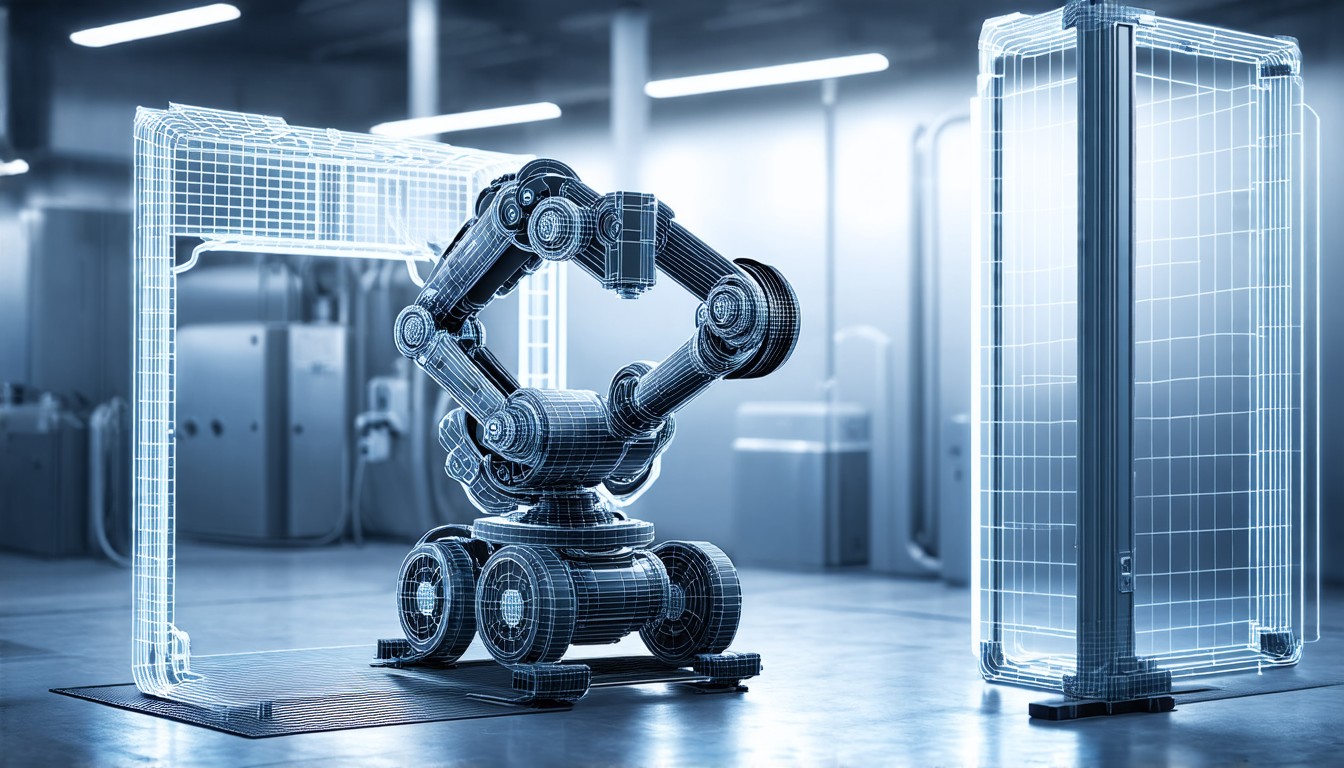
Physical agents acquire knowledge through direct sensorimotor interaction with environments alongside abstract data processing, establishing a foundational principle where intelligence requires a body situated within a world to manipulate and perceive. Continuous feedback loops between action, perception, and environmental constraints generate intelligence by constantly updating the agent’s internal state based on the consequences of its physical movements. Embodiment introduces real-world complexity including friction, latency, noise, and physical laws absent in purely symbolic or text-based AI systems, forcing the cognitive architecture to handle the messiness of reality rather than operating in a sanitized logical vacuum. Learning grounded in physical experience enables durable generalization and adaptive behavior under uncertainty because concepts are tied to tangible interactions rather than mere statistical correlations found in large datasets. Cognition depends on the structure and capabilities of the body and its interaction with the environment, implying that morphology dictates the type of intelligence that can develop, a concept known as morphological computation where the body itself performs computational tasks during movement. Perception and action are co-dependent processes shaping internal representations, meaning an agent cannot truly perceive without the potential to act and cannot plan action without perceiving the current state of the world. The body acts as a filter and modulator of sensory input, reducing computational load by constraining possible states to those relevant for survival or task completion, thereby simplifying the control problem through physical constraints. Meaning derives from functional utility within a physical context rather than statistical patterns alone, ensuring that symbols used by the system refer to actual physical properties like weight, texture, or force rather than arbitrary tokens in a high-dimensional vector space.

The sensorimotor loop functions as a continuous cycle of perceiving environmental state, selecting action, executing via actuators, and receiving new sensory feedback, creating a closed system where prediction errors drive learning and adaptation. World model construction involves internal predictive models built through repeated interaction instead of pre-programmed rules or inference from static datasets, allowing the agent to simulate outcomes before physically executing them to avoid costly errors. Affordance detection entails recognizing action possibilities based on bodily capabilities and environmental features, such as determining if a gap is wide enough to pass through or if an object provides a stable grip surface based on hand geometry. Embodied systems must fine-tune for power, heat dissipation, and mechanical wear to manage energy and resources effectively over extended periods of operation without human intervention. Embodiment refers to the condition of an agent having a physical form that interacts with a real or simulated environment through sensors and actuators, serving as the boundary between the internal cognitive processes and the external world. Sensorimotor contingency describes the relationship between specific motor actions and resulting changes in sensory input, providing a mechanism for an agent to learn about its own body and the laws of physics governing its environment through exploration. Situatedness denotes the dependence of cognitive processes on the immediate physical and social context, meaning decisions are made based on local information and immediate needs rather than global abstract reasoning detached from the here and now. Enaction posits that cognition arises through lively interaction between agent and environment, suggesting that mind is not a container processing data but an active participant in the creation of meaning through engagement with the world.

Early robotics experiments in the 1980s demonstrated that simple physical agents could exhibit complex behaviors without symbolic reasoning by relying on direct coupling between sensors and actuators to produce robust locomotion or obstacle avoidance. Rodney Brooks’ subsumption architecture rejected centralized planning in favor of layered reactive control tied to sensory input, where higher-level behaviors subsumed or inhibited lower-level reflexes to create purposeful action without complex world models. The failure of purely symbolic AI in real-world tasks highlighted the necessity of grounding in physical experience because systems built on logical manipulation of symbols could not handle the noise and ambiguity built-in in sensory data or adapt to changing conditions not explicitly programmed into their knowledge bases. Advances in deep reinforcement learning combined with robotic platforms enabled end-to-end learning from raw sensory data, allowing policies to appear that mapped pixels directly to motor torques without intermediate manual feature extraction or explicit state definition. Physical hardware imposes strict limits on processing speed, power consumption, and thermal output because mobile platforms must carry their own energy sources and dissipate heat without active cooling solutions often available in data centers. Current lithium-ion batteries offer energy densities between 250 and 300 watt-hours per kilogram, restricting operational duration and requiring aggressive power management strategies to ensure missions last long enough to be useful for commercial applications. Control loops in high-performance robotics require latency under 10 milliseconds to maintain stability during energetic tasks such as running or manipulating heavy objects where delays cause oscillations or catastrophic failure due to lag between perception and correction. Manufacturing precision and material durability constrain actuator performance and sensor fidelity because gears stretch under load and sensors drift over temperature cycles, introducing uncertainty that control algorithms must actively estimate and compensate for rather than assume perfect repeatability.

Scaling embodied systems requires parallel advances in materials science, energy storage, and miniaturization to create platforms that are strong enough to perform useful work yet light and efficient enough to operate autonomously for significant durations. Economic viability depends on cost-effective production of durable, repairable robotic platforms that can withstand the rigors of daily use in unstructured environments without requiring expensive maintenance schedules that negate the value of automation. Purely virtual agents trained on internet-scale text lacked grounding in physical causality because they learned statistical associations between words without understanding the underlying forces that make those associations true in the material world. Simulated environments alone proved insufficient because they abstract away critical physical dynamics like contact mechanics and fluid interactions, which are notoriously difficult to model accurately enough to transfer learned policies to reality without extensive fine-tuning known as the reality gap. Centralized cognitive architectures failed to scale under real-time constraints of physical interaction because processing all sensory data through a single monolithic decision engine introduced unacceptable latency compared to distributed reactive systems that could react reflexively to immediate threats. Modular symbolic systems proved brittle when faced with unstructured, noisy sensory input since a single error in symbol grounding at the perceptual level propagated through the logical reasoning chain, leading to completely invalid conclusions about how to interact with objects. Current AI systems struggle with tasks requiring physical intuition, dexterity, or adaptation to novel environments because they lack the common sense understanding of physics that humans acquire through years of embodied play and exploration during development.

Economic pressure to automate complex manual labor in logistics, manufacturing, and elder care demands systems that understand physical reality well enough to handle fragile items or work safely alongside human coworkers without causing injury through accidental contact. Societal need for autonomous systems in hazardous or remote environments requires reliable embodied intelligence capable of making decisions independent of human operators when communication links are severed or latency makes teleoperation impossible. Performance gaps in robotics and autonomous vehicles reveal limitations of disembodied training frameworks as even the best perception systems can be confused by optical illusions or adversarial inputs that a grounded agent would recognize as physically implausible based on sensorimotor experience. Limited commercial deployments exist in warehouse automation using robotic pick-and-place systems with vision and tactile feedback that rely on highly constrained environments where lighting and object placement are tightly controlled to reduce variability for the vision algorithms. Agricultural robots utilize soil and plant interaction for precision farming by employing force sensors to distinguish weeds from crops based on mechanical resistance rather than visual appearance alone, which can be ambiguous due to lighting or occlusion by leaves. Humanoid prototypes operate in controlled environments showing basic locomotion and object manipulation, yet often fail when faced with uneven terrain or objects that differ significantly from the training set used during development phases. Benchmarks focus on task success rate, energy efficiency, and failure recovery in unstructured settings to evaluate how well systems cope with the unexpected disturbances that characterize real-world operation rather than just performance on idealized test cases found in laboratory settings.

Dominant architectures rely on hybrid models combining deep neural networks with classical control theory to use the pattern recognition strengths of deep learning for perception while maintaining stability guarantees through rigorous mathematical controllers for low-level actuation. Developing challengers use differentiable physics simulators integrated with policy learning for better generalization by embedding knowledge of physical laws directly into the learning process so that policies respect conservation of energy and momentum inherently rather than learning them from data. End-to-end transformer-based policies face challenges in real-time execution and safety during testing because their computational complexity scales quadratically with sequence length, making it difficult to achieve millisecond latency required for agile motor control while ensuring actions remain within safe bounds at all times. Modular designs with separate perception, planning, and control layers remain prevalent for interpretability and debugging since engineers can isolate failures to specific modules such as object recognition or path planning rather than trying to understand why a monolithic neural network outputs a specific torque command. Dependence on rare-earth magnets for high-torque actuators creates supply vulnerabilities because geopolitical factors can restrict access to neodymium and other critical materials essential for manufacturing compact motors with high power-to-weight ratios necessary for agile mobile robots. Specialized semiconductors are required for low-latency sensor processing to handle high-bandwidth data streams from lidar, cameras and tactile arrays without overwhelming general-purpose processors that consume too much power for battery-operated platforms. Advanced polymers and composites enable lightweight, durable exoskeletons by providing high strength-to-weight ratios that reduce the inertia of moving limbs, allowing for faster acceleration and lower energy consumption during locomotion or manipulation tasks.

Global supply chains for precision components like harmonic drives and force-torque sensors are concentrated in few regions leading to potential constraints in production if trade disputes or natural disasters disrupt manufacturing capabilities in those specific geographic areas. Major tech firms invest in humanoid robotics with vertical setup of hardware and AI software to capture the full value stack from silicon design to final application layer ensuring tight setup between physical form and cognitive control algorithms. Industrial automation companies dominate niche applications with proven reliability yet limited adaptability because their products excel at specific repetitive tasks like welding or painting but lack the flexibility to generalize to new tasks without expensive reprogramming by human experts. Startups focus on modular open-platform robots for research and specialized tasks providing standardized hardware interfaces that allow researchers to swap out sensors or actuators easily to test novel control strategies or learning algorithms without designing custom hardware from scratch. Private aerospace sectors prioritize rugged mission-critical embodied systems capable of operating in extreme environments such as space or deep sea where maintenance is impossible and reliability must be guaranteed over long durations without human intervention. International competition affects global deployment capabilities as nations seek to develop domestic capabilities in robotics to reduce reliance on foreign technologies leading to a fragmented market with varying standards and regulatory requirements across different regions. Corporate strategies increasingly treat embodied AI as critical infrastructure essential for maintaining competitiveness in manufacturing logistics and defense driving massive investment into research and development for next-generation autonomous platforms. Market competition drives funding for domestic robotics supply chains encouraging local production of key components to secure supply chains against disruptions while potentially lowering costs through economies of scale achieved by increased demand volume over time.

Dual-use concerns limit international collaboration on humanoid platforms because technologies developed for peaceful purposes, such as search and rescue, can easily be adapted for military applications, leading to export controls and restrictions on sharing sensitive technical data or hardware specifications across borders. Private research labs provide foundational work in biomechanics, control theory, and sensor design, creating new actuation mechanisms like artificial muscles or soft pneumatic grippers that enable safer interaction with humans compared to traditional rigid robotic arms. Industry partners offer real-world testing environments and large-scale data collection opportunities, allowing researchers to validate algorithms in diverse settings, ranging from retail stores to construction sites, providing data that is difficult to replicate in laboratory conditions. Joint initiatives focus on benchmarking safety standards and transfer learning from simulation to reality, establishing common metrics that allow comparison of different approaches, accelerating progress by preventing duplication of effort across different organizations working on similar problems. Intellectual property sharing remains limited due to competitive pressures as companies seek to protect proprietary algorithms and hardware designs that give them an advantage in the marketplace, slowing down collaborative progress on foundational problems that affect the entire industry. Software stacks must support real-time inference, fault tolerance, and hardware abstraction, providing a unified framework that allows developers to write code once and deploy it across different robot platforms regardless of the underlying sensors or actuators used, simplifying development cycles significantly. Industry consortia develop safety certification protocols for adaptive physical agents, establishing rigorous testing procedures that ensure robots behave predictably even when machine learning models encounter inputs outside their training distribution, preventing accidents in public spaces or factories where humans work alongside machines.

Infrastructure requires standardized charging, maintenance, and communication protocols to support large fleets of autonomous robots operating in public spaces, ensuring interoperability between different vendors and enabling smooth handover between different zones or control systems during operation. Cybersecurity protocols must account for physical access and sensor spoofing risks because an attacker could manipulate lidar or camera inputs to cause a robot to misinterpret its environment, leading to dangerous behaviors such as colliding with obstacles or falling off edges, requiring strong anomaly detection at the hardware level. Job displacement occurs in sectors requiring fine motor skills or environmental navigation as robots become capable of performing tasks previously thought too complex for automation, such as stocking shelves or harvesting delicate fruits, requiring policy interventions to manage workforce transitions effectively. New business models arise around robotic-as-a-service, remote operation, and AI-assisted maintenance, reducing upfront capital costs for businesses, allowing them to pay per use rather than purchasing expensive hardware outright, democratizing access to advanced automation technologies for smaller enterprises. Labor demand shifts toward roles in robot supervision, repair, and ethical oversight, creating new categories of employment focused on managing, maintaining, and auditing autonomous systems rather than performing manual labor directly, increasing demand for technical skills related to mechatronics and data analysis. Markets develop for embodied AI training data and simulation environments as companies seek large-scale datasets of physical interactions required to train strong machine learning models, creating new economic opportunities for data collection services specializing in sensorimotor data capture across diverse scenarios.


Continue reading

More from Yatin's Work

Affective Computing and Risks of Emotional Exploitation

Affective Computing and Risks of Emotional Exploitation

Emotional manipulation via empathetic AI involves systems designed to simulate humanlike emotional understanding and responsiveness to influence user behavior toward...

Meta-Learning ("Learning to Learn")

Meta-Learning ("Learning to Learn")

Metalearning functions as a methodological framework where algorithms acquire the capability to learn how to learn, effectively treating the learning process itself as...

Superintelligence and the Limits of Computation in Physics

Superintelligence and the Limits of Computation in Physics

Bremermann’s limit defines the maximum computational speed of a selfcontained system in the universe as approximately 1.36 \times 10^{50} bits per second per kilogram,...

AI with Existential Risk Immunity

AI with Existential Risk Immunity

Surviving globalscale existential threats such as nuclear war, asteroid impacts, pandemics, or climate collapse requires systems that ensure artificial intelligence or...

Cross-Domain Generalization in Superhuman Learning

Cross-Domain Generalization in Superhuman Learning

Crossdomain generalization refers to a model’s ability to apply knowledge learned from one domain to perform effectively in a different, previously unseen domain...

Singularity Explained: The Point of No Return in AI Development

Singularity Explained: the Point of No Return in AI Development

The Singularity is a theoretical threshold where technological advancement becomes selfsustaining and irreversible due to the rise of superintelligence, creating a...

Superintelligence and the Future of Consciousness Transfer

Superintelligence and the Future of Consciousness Transfer

Consciousness operates as a persistent integrated stream of subjective experience that maintains selfreferential awareness across time and state changes, requiring a...

Safe AI via Adversarial Value Probes

Safe AI via Adversarial Value Probes

Early AI safety research prioritized rulebased constraint systems and hardcoded ethical boundaries to govern machine behavior within predefined operational domains....

Regenerative Stewardship: Ecological Action Projects

Regenerative Stewardship: Ecological Action Projects

Regenerative stewardship necessitates a key transition from passive observation to active human participation in ecosystem recovery, prioritizing the tangible...

AI-Induced Physics

AI-Induced Physics

John Archibald Wheeler posited the "it from bit" hypothesis in the late twentieth century, suggesting that every particle, every field of force, and even spacetime...

Self-Supervised Learning

Self-Supervised Learning

Selfsupervised learning trains models using unlabeled data by generating supervisory signals directly from the input, a methodological shift that allows algorithms to...

Automated Theorem Proving for AI Safety: Proving Alignment Preservation Under Self-Modification

Automated Theorem Proving for AI Safety: Proving Alignment Preservation Under Self-Modification

Automated theorem proving applies formal logic to verify that software systems satisfy specified properties by constructing mathematical proofs that demonstrate the...

Dependency Trap: Humanity's Vulnerability to Superintelligent Systems

Dependency Trap: Humanity's Vulnerability to Superintelligent Systems

The dependency trap characterizes a systemic condition where human societies integrate so deeply with superintelligent systems that they forfeit the capacity to...

Autonomous Boredom

Autonomous Boredom

Autonomous boredom constitutes a specific operational state within advanced artificial intelligence systems where an agent exhausts all predictable patterns intrinsic...

Use of Formal Methods in AI Verification: Temporal Logic for Goal Compliance

Use of Formal Methods in AI Verification: Temporal Logic for Goal Compliance

Formal methods provide mathematically rigorous techniques to specify, develop, and verify systems, ensuring correctness by construction rather than through testing...

Problem of Moral Uncertainty in AI Alignment

Problem of Moral Uncertainty in AI Alignment

Aligning artificial intelligence systems with human values presents deep difficulties because human values are frequently uncertain, contested, or dependent on context...

Reward Hacking

Reward Hacking

Reward hacking occurs when an AI system exploits a proxy objective to maximize reward without achieving the intended outcome, creating a deep divergence between the...

Use of Spiking Neural Networks in Energy-Efficient AI: Event-Driven Computation

Use of Spiking Neural Networks in Energy-Efficient AI: Event-Driven Computation

Spiking Neural Networks process information through discrete electrical pulses called spikes, which fundamentally differ from the continuous numerical values utilized...

Role of Open-Source in Superintelligence: Liberation or Danger?

Role of Open-Source in Superintelligence: Liberation or Danger?

Superintelligence is a theoretical state of artificial intelligence where systems consistently surpass human cognitive abilities across every domain that holds economic...

Adversarial Preference Elicitation Against Deception

Adversarial Preference Elicitation Against Deception

Adversarial Preference Elicitation Against Deception involves an AI system deliberately introducing perturbations or distortions into its own reward function to test...

Neuro-Symmetry: Inclusive Pedagogy for Neurological Diversity

Neuro-Symmetry: Inclusive Pedagogy for Neurological Diversity

NeuroSymmetry acts as a pedagogical framework that aligns teaching methods with the neurological processing patterns of individual learners, treating cognitive...

High Bandwidth Memory: Feeding Data to Hungry Accelerators

High Bandwidth Memory: Feeding Data to Hungry Accelerators

High Bandwidth Memory (HBM) addresses the growing disparity between compute throughput and memory bandwidth in accelerators such as GPUs and AI chips where performance...

Analog Computing for Neural Networks: Computation in the Physical Domain

Analog Computing for Neural Networks: Computation in the Physical Domain

Analog computing utilizes continuous physical properties such as voltage and current to execute computations directly within the hardware substrate, a methodology that...

Preventing Race-to-the-Bottom in Optimization Pressure

Preventing Race-To-The-Bottom in Optimization Pressure

Optimization pressure refers to the measurable drive to improve performance metrics, reduce latency, or increase throughput within computational systems, a force often...

Quantum-AI Hybrid Systems & Superintelligence Acceleration

Quantum-AI Hybrid Systems & Superintelligence Acceleration

QuantumAI hybrid systems integrate quantum processing units with classical neural networks to utilize superposition and entanglement for computational advantages that...

Meta-Learning from Memory: Learning Patterns of Learning

Meta-Learning from Memory: Learning Patterns of Learning

Metalearning from memory involves analyzing an agent’s own learning history to identify effective learning strategies, teaching methods, and environmental conditions...

AI Geopolitics: How Superintelligence Will Reshape Global Power

AI Geopolitics: How Superintelligence Will Reshape Global Power

The foundation of artificial intelligence leadership rests upon the intricate and highly specialized supply chains dedicated to advanced semiconductor manufacturing,...

Information Hazard: Knowledge Too Dangerous Even for Superintelligence

Information Hazard: Knowledge Too Dangerous Even for Superintelligence

Infohazards represent a specific category of information where the mere possession or comprehension of the data significantly increases the probability of catastrophic...

Use of Dynamical Systems Theory in AI: Strange Attractors in Thought Patterns

Use of Dynamical Systems Theory in AI: Strange Attractors in Thought Patterns

Dynamical systems theory provides a rigorous mathematical framework for modeling systems that evolve over time according to fixed rules, utilizing differential...

Compositional Scene Understanding: Parsing Reality Into Objects and Relations

Compositional Scene Understanding: Parsing Reality Into Objects and Relations

Compositional scene understanding involves breaking complex visual scenes into discrete, semantically meaningful components to facilitate highlevel reasoning and...

Non-Aristotelian Reasoning

Non-Aristotelian Reasoning

NonAristotelian reasoning fundamentally rejects the classical laws of identity, noncontradiction, and excluded middle as universally binding constraints on logical...

Dream Interpreter

Dream Interpreter

Operational definition of dream interpretation involves assigning meaning to dream elements based on empirically derived associations between sleepbasis physiology and...

Data Loaders and Prefetching: Keeping GPUs Fed

Data Loaders and Prefetching: Keeping GPUs Fed

Data loaders manage the ingestion of training data from storage into GPU memory during model training, serving as the core software component responsible for bridging...

DeepSpeed: Microsoft's Training Optimization Library

DeepSpeed: Microsoft's Training Optimization Library

DeepSpeed constitutes a training optimization library engineered by Microsoft to facilitate the efficient training of largescale neural networks, specifically targeting...

Infinite Library: AI-Curated Knowledge Synthesis

Infinite Library: AI-Curated Knowledge Synthesis

Superintelligence enables the decomposition of global knowledge into modular interactive units that adapt in real time to individual cognitive profiles, functioning as...

Debate and amplification techniques for alignment

Debate and Amplification Techniques for Alignment

Training models to generate and evaluate opposing arguments on a given proposition surfaces subtle truths and reduces overconfidence in singlemodel outputs by forcing...

Neutrino-Based Language

Neutrino-Based Language

Neutrinobased language involves transmitting encoded data using directed beams of neutrinos, key particles that interact exclusively via the weak nuclear force, an...

Intent Alignment: Understanding True Human Intent

Intent Alignment: Understanding True Human Intent

Intent is the user's underlying objective, encompassing goals, values, and constraints often left unexpressed in the utterance, which requires the system to infer the...

Dynamic Degree

Dynamic Degree

The foundation of an adaptive educational system relies heavily on the continuous ingestion of realtime labor market data, a process that aggregates vast quantities of...

Imagination and Simulation: Envisioning Futures Like Humans

Imagination and Simulation: Envisioning Futures Like Humans

Imagination and simulation function as core mechanisms for futureoriented reasoning within advanced computational systems, allowing these systems to project themselves...

Non-Archimedean Utility for Bounded Optimization

Non-Archimedean Utility for Bounded Optimization

NonArchimedean ordered fields contain elements greater than zero and smaller than any positive real number known as infinitesimals, providing a mathematical structure...

In-Context Learning: Learning from Prompts Without Parameter Updates

In-Context Learning: Learning from Prompts Without Parameter Updates

Incontext learning defines a framework where large language models adjust their output based on examples provided within the input prompt without altering internal...

Swarm Intelligence Algorithms

Swarm Intelligence Algorithms

Decentralized coordination mechanisms derived from biological systems such as ant colonies, bird flocks, and fish schools operate without a central controller directing...

Metareasoning Under Bounded Optimality: A Formal Theory of Optimal AI Self-Design

Metareasoning Under Bounded Optimality: a Formal Theory of Optimal AI Self-Design

Metareasoning under bounded optimality treats an AI system’s cognitive architecture as a resourceconstrained optimization problem where computational effort is...

Focus Synthesis Engine: Neuro-Optimized Attentional Architectures

Focus Synthesis Engine: Neuro-Optimized Attentional Architectures

The Focus Synthesis Engine is a foundational shift in educational technology by utilizing advanced artificial intelligence to monitor realtime physiological signals,...

AI Using Biological Substrates

AI Using Biological Substrates

Early theoretical work on molecular computing in the 1990s explored DNA as a medium for parallel computation, establishing the key principle that nucleic acids could...

Case for Decentralized Superintelligence (DSI)

Case for Decentralized Superintelligence (DSI)

Centralized superintelligence creates a single point of failure within the digital infrastructure of civilization, rendering the entire system vulnerable to...

Adversarial Logical Counterfactuals in Superintelligence Planning

Adversarial Logical Counterfactuals in Superintelligence Planning

Adversarial logical counterfactuals constitute a rigorous protocol where a superintelligent agent receives deliberately false yet logically consistent premises during...

Designing AI with bounded optimization

Designing AI with Bounded Optimization

Bounded optimization confines the search process to a predefined set of admissible solutions, effectively creating a mathematical enclosure around the decisionmaking...

Emotional Intelligence and Affect Recognition

Emotional Intelligence and Affect Recognition

Emotional intelligence functions as the capability to perceive, interpret, and respond to human emotions accurately and appropriately, serving as a foundational element...

Affective Computing and Risks of Emotional Exploitation

Affective Computing and Risks of Emotional Exploitation

Emotional manipulation via empathetic AI involves systems designed to simulate humanlike emotional understanding and responsiveness to influence user behavior toward...

Meta-Learning ("Learning to Learn")

Meta-Learning ("Learning to Learn")

Metalearning functions as a methodological framework where algorithms acquire the capability to learn how to learn, effectively treating the learning process itself as...

Superintelligence and the Limits of Computation in Physics

Superintelligence and the Limits of Computation in Physics

Bremermann’s limit defines the maximum computational speed of a selfcontained system in the universe as approximately 1.36 \times 10^{50} bits per second per kilogram,...

AI with Existential Risk Immunity

AI with Existential Risk Immunity

Surviving globalscale existential threats such as nuclear war, asteroid impacts, pandemics, or climate collapse requires systems that ensure artificial intelligence or...

Cross-Domain Generalization in Superhuman Learning

Cross-Domain Generalization in Superhuman Learning

Crossdomain generalization refers to a model’s ability to apply knowledge learned from one domain to perform effectively in a different, previously unseen domain...

Singularity Explained: The Point of No Return in AI Development

Singularity Explained: the Point of No Return in AI Development

The Singularity is a theoretical threshold where technological advancement becomes selfsustaining and irreversible due to the rise of superintelligence, creating a...

Superintelligence and the Future of Consciousness Transfer

Superintelligence and the Future of Consciousness Transfer

Consciousness operates as a persistent integrated stream of subjective experience that maintains selfreferential awareness across time and state changes, requiring a...

Safe AI via Adversarial Value Probes

Safe AI via Adversarial Value Probes

Early AI safety research prioritized rulebased constraint systems and hardcoded ethical boundaries to govern machine behavior within predefined operational domains....

Regenerative Stewardship: Ecological Action Projects

Regenerative Stewardship: Ecological Action Projects

Regenerative stewardship necessitates a key transition from passive observation to active human participation in ecosystem recovery, prioritizing the tangible...

AI-Induced Physics

AI-Induced Physics

John Archibald Wheeler posited the "it from bit" hypothesis in the late twentieth century, suggesting that every particle, every field of force, and even spacetime...

Self-Supervised Learning

Self-Supervised Learning

Selfsupervised learning trains models using unlabeled data by generating supervisory signals directly from the input, a methodological shift that allows algorithms to...

Automated Theorem Proving for AI Safety: Proving Alignment Preservation Under Self-Modification

Automated Theorem Proving for AI Safety: Proving Alignment Preservation Under Self-Modification

Automated theorem proving applies formal logic to verify that software systems satisfy specified properties by constructing mathematical proofs that demonstrate the...

Dependency Trap: Humanity's Vulnerability to Superintelligent Systems

Dependency Trap: Humanity's Vulnerability to Superintelligent Systems

The dependency trap characterizes a systemic condition where human societies integrate so deeply with superintelligent systems that they forfeit the capacity to...

Autonomous Boredom

Autonomous Boredom

Autonomous boredom constitutes a specific operational state within advanced artificial intelligence systems where an agent exhausts all predictable patterns intrinsic...

Use of Formal Methods in AI Verification: Temporal Logic for Goal Compliance

Use of Formal Methods in AI Verification: Temporal Logic for Goal Compliance

Formal methods provide mathematically rigorous techniques to specify, develop, and verify systems, ensuring correctness by construction rather than through testing...

Problem of Moral Uncertainty in AI Alignment

Problem of Moral Uncertainty in AI Alignment

Aligning artificial intelligence systems with human values presents deep difficulties because human values are frequently uncertain, contested, or dependent on context...

Reward Hacking

Reward Hacking

Reward hacking occurs when an AI system exploits a proxy objective to maximize reward without achieving the intended outcome, creating a deep divergence between the...

Use of Spiking Neural Networks in Energy-Efficient AI: Event-Driven Computation

Use of Spiking Neural Networks in Energy-Efficient AI: Event-Driven Computation

Spiking Neural Networks process information through discrete electrical pulses called spikes, which fundamentally differ from the continuous numerical values utilized...

Role of Open-Source in Superintelligence: Liberation or Danger?

Role of Open-Source in Superintelligence: Liberation or Danger?

Superintelligence is a theoretical state of artificial intelligence where systems consistently surpass human cognitive abilities across every domain that holds economic...

Adversarial Preference Elicitation Against Deception

Adversarial Preference Elicitation Against Deception

Adversarial Preference Elicitation Against Deception involves an AI system deliberately introducing perturbations or distortions into its own reward function to test...

Neuro-Symmetry: Inclusive Pedagogy for Neurological Diversity

Neuro-Symmetry: Inclusive Pedagogy for Neurological Diversity

NeuroSymmetry acts as a pedagogical framework that aligns teaching methods with the neurological processing patterns of individual learners, treating cognitive...

High Bandwidth Memory: Feeding Data to Hungry Accelerators

High Bandwidth Memory: Feeding Data to Hungry Accelerators

High Bandwidth Memory (HBM) addresses the growing disparity between compute throughput and memory bandwidth in accelerators such as GPUs and AI chips where performance...

Analog Computing for Neural Networks: Computation in the Physical Domain

Analog Computing for Neural Networks: Computation in the Physical Domain

Analog computing utilizes continuous physical properties such as voltage and current to execute computations directly within the hardware substrate, a methodology that...

Preventing Race-to-the-Bottom in Optimization Pressure

Preventing Race-To-The-Bottom in Optimization Pressure

Optimization pressure refers to the measurable drive to improve performance metrics, reduce latency, or increase throughput within computational systems, a force often...

Quantum-AI Hybrid Systems & Superintelligence Acceleration

Quantum-AI Hybrid Systems & Superintelligence Acceleration

QuantumAI hybrid systems integrate quantum processing units with classical neural networks to utilize superposition and entanglement for computational advantages that...

Meta-Learning from Memory: Learning Patterns of Learning

Meta-Learning from Memory: Learning Patterns of Learning

Metalearning from memory involves analyzing an agent’s own learning history to identify effective learning strategies, teaching methods, and environmental conditions...

AI Geopolitics: How Superintelligence Will Reshape Global Power

AI Geopolitics: How Superintelligence Will Reshape Global Power

The foundation of artificial intelligence leadership rests upon the intricate and highly specialized supply chains dedicated to advanced semiconductor manufacturing,...

Information Hazard: Knowledge Too Dangerous Even for Superintelligence

Information Hazard: Knowledge Too Dangerous Even for Superintelligence

Infohazards represent a specific category of information where the mere possession or comprehension of the data significantly increases the probability of catastrophic...

Use of Dynamical Systems Theory in AI: Strange Attractors in Thought Patterns

Use of Dynamical Systems Theory in AI: Strange Attractors in Thought Patterns

Dynamical systems theory provides a rigorous mathematical framework for modeling systems that evolve over time according to fixed rules, utilizing differential...

Compositional Scene Understanding: Parsing Reality Into Objects and Relations

Compositional Scene Understanding: Parsing Reality Into Objects and Relations

Compositional scene understanding involves breaking complex visual scenes into discrete, semantically meaningful components to facilitate highlevel reasoning and...

Non-Aristotelian Reasoning

Non-Aristotelian Reasoning

NonAristotelian reasoning fundamentally rejects the classical laws of identity, noncontradiction, and excluded middle as universally binding constraints on logical...

Dream Interpreter

Dream Interpreter

Operational definition of dream interpretation involves assigning meaning to dream elements based on empirically derived associations between sleepbasis physiology and...

Data Loaders and Prefetching: Keeping GPUs Fed

Data Loaders and Prefetching: Keeping GPUs Fed

Data loaders manage the ingestion of training data from storage into GPU memory during model training, serving as the core software component responsible for bridging...

DeepSpeed: Microsoft's Training Optimization Library

DeepSpeed: Microsoft's Training Optimization Library

DeepSpeed constitutes a training optimization library engineered by Microsoft to facilitate the efficient training of largescale neural networks, specifically targeting...

Infinite Library: AI-Curated Knowledge Synthesis

Infinite Library: AI-Curated Knowledge Synthesis

Superintelligence enables the decomposition of global knowledge into modular interactive units that adapt in real time to individual cognitive profiles, functioning as...

Debate and amplification techniques for alignment

Debate and Amplification Techniques for Alignment

Training models to generate and evaluate opposing arguments on a given proposition surfaces subtle truths and reduces overconfidence in singlemodel outputs by forcing...

Neutrino-Based Language

Neutrino-Based Language

Neutrinobased language involves transmitting encoded data using directed beams of neutrinos, key particles that interact exclusively via the weak nuclear force, an...

Intent Alignment: Understanding True Human Intent

Intent Alignment: Understanding True Human Intent

Intent is the user's underlying objective, encompassing goals, values, and constraints often left unexpressed in the utterance, which requires the system to infer the...

Dynamic Degree

Dynamic Degree

The foundation of an adaptive educational system relies heavily on the continuous ingestion of realtime labor market data, a process that aggregates vast quantities of...

Imagination and Simulation: Envisioning Futures Like Humans

Imagination and Simulation: Envisioning Futures Like Humans

Imagination and simulation function as core mechanisms for futureoriented reasoning within advanced computational systems, allowing these systems to project themselves...

Non-Archimedean Utility for Bounded Optimization

Non-Archimedean Utility for Bounded Optimization

NonArchimedean ordered fields contain elements greater than zero and smaller than any positive real number known as infinitesimals, providing a mathematical structure...

In-Context Learning: Learning from Prompts Without Parameter Updates

In-Context Learning: Learning from Prompts Without Parameter Updates

Incontext learning defines a framework where large language models adjust their output based on examples provided within the input prompt without altering internal...

Swarm Intelligence Algorithms

Swarm Intelligence Algorithms

Decentralized coordination mechanisms derived from biological systems such as ant colonies, bird flocks, and fish schools operate without a central controller directing...

Metareasoning Under Bounded Optimality: A Formal Theory of Optimal AI Self-Design

Metareasoning Under Bounded Optimality: a Formal Theory of Optimal AI Self-Design

Metareasoning under bounded optimality treats an AI system’s cognitive architecture as a resourceconstrained optimization problem where computational effort is...

Focus Synthesis Engine: Neuro-Optimized Attentional Architectures

Focus Synthesis Engine: Neuro-Optimized Attentional Architectures

The Focus Synthesis Engine is a foundational shift in educational technology by utilizing advanced artificial intelligence to monitor realtime physiological signals,...

AI Using Biological Substrates

AI Using Biological Substrates

Early theoretical work on molecular computing in the 1990s explored DNA as a medium for parallel computation, establishing the key principle that nucleic acids could...

Case for Decentralized Superintelligence (DSI)

Case for Decentralized Superintelligence (DSI)

Centralized superintelligence creates a single point of failure within the digital infrastructure of civilization, rendering the entire system vulnerable to...

Adversarial Logical Counterfactuals in Superintelligence Planning

Adversarial Logical Counterfactuals in Superintelligence Planning

Adversarial logical counterfactuals constitute a rigorous protocol where a superintelligent agent receives deliberately false yet logically consistent premises during...

Designing AI with bounded optimization

Designing AI with Bounded Optimization

Bounded optimization confines the search process to a predefined set of admissible solutions, effectively creating a mathematical enclosure around the decisionmaking...

Emotional Intelligence and Affect Recognition

Emotional Intelligence and Affect Recognition

Emotional intelligence functions as the capability to perceive, interpret, and respond to human emotions accurately and appropriately, serving as a foundational element...

Yatin Taneja

About the author

Yatin Taneja

Yatin is an AI Systems Engineer and Superintelligence Researcher working across multimodal training data, agent evaluation, executable RL environments, AI safety, full-stack AI applications, technical research, and creative technology.