Knowledge hub
Language Grounding: Connecting Words to Reality

Language grounding refers to the process by which linguistic symbols acquire meaning through direct interaction with the physical world, establishing a core link between abstract tokens and concrete entities. Meaning derives from sensorimotor experience where a system understands a concept like a cup through seeing, touching, lifting, and using one, rather than processing a textual definition alone. Isomorphic semantic grounding ensures internal representations of words structurally mirror real-world entities and actions, creating a direct mapping between the cognitive architecture of the system and the geometry of the environment. This approach reduces symbol-reality misalignment by anchoring abstract concepts in concrete, observable data streams such as vision, touch, sound, and proprioception. Grounded systems learn word meanings through embodied interaction involving manipulating objects, managing environments, and responding to feedback loops that validate or refute their internal predictions. The core mechanism involves a perception-action-language loop where sensory input informs linguistic interpretation while simultaneously updating the system’s understanding of the environment.

Linguistic commands guide physical actions with continuous validation against environmental outcomes to ensure the intended result matches the actual physical change. Learning occurs via multimodal alignment synchronizing visual, auditory, tactile, and kinematic data with linguistic labels to create a strong representation of reality that encompasses multiple sensory modalities simultaneously. Semantic representations function as lively, context-sensitive constructs updated through real-time interaction rather than static entries in a database or lookup table. Error correction happens intrinsically when a mismatch between expected and actual outcome refines visual recognition and word association, allowing the system to self-correct without explicit external intervention. Generalization relies on shared structural invariants across experiences such as a handle implying graspability, enabling the system to interact with novel objects based on their physical properties rather than prior specific exposure. Grounding involves the measurable correlation between a linguistic token and a specific sensorimotor event, providing a quantifiable metric for the strength of the association between a word and its physical counterpart.
Embodiment requires the system to possess sensors and actuators enabling interaction with a physical or simulated environment, making the physical presence or high-fidelity simulation a prerequisite for true language understanding. Isomorphism denotes structural similarity between internal representational space and external physical reality, ensuring that distances and relationships between concepts in the system’s “mind” reflect actual distances and relationships in the real world. The symbol-reality gap is the divergence between predicted outcomes based on language alone and actual outcomes observed in the environment, serving as a critical measure of the system’s alignment with reality. Multimodal alignment entails temporal and spatial synchronization of linguistic inputs with non-linguistic sensory streams to ensure that the system associates the correct word with the correct sensory event at the precise moment it occurs. Early symbolic AI assumed meaning could be defined purely through logic and dictionaries, an approach that failed to scale due to a lack of real-world referents to anchor the symbols in experience. Statistical language models captured co-occurrence patterns yet produced brittle, ungrounded outputs that often failed when applied to physical tasks requiring an understanding of object permanence or physics.
The adoption of embodied cognition in robotics during the 2000s and 2010s demonstrated that agents learning through interaction developed durable language understanding superior to purely text-based training methods. Large-scale multimodal datasets like EPIC-KITCHENS and ALFRED enabled training models associating language with video and action sequences, providing the raw data necessary for learning the correlations between words and physical movements. Recent setup of large language models with robotic control systems marked a pivot from passive text prediction to active, grounded language use where the system generates actions based on linguistic input. Dominant architectures combine vision-language models like CLIP and Flamingo with robotic policy networks to translate natural language instructions into executable motor commands. These networks undergo training via reinforcement learning from human feedback to refine their policy based on the success or failure of physical actions in the real world. Developing challengers use neurosymbolic frameworks explicitly representing object affordances and physical constraints to combine the pattern recognition of neural networks with the logic of symbolic AI.
Some systems adopt modular designs with separate perception, planning, and execution modules to allow for specialized processing at each basis of the task pipeline. End-to-end differentiable models face struggles with long-goal tasks requiring persistent memory of grounded states over extended periods of interaction and manipulation. Hybrid approaches pre-train on internet-scale text and fine-tune on embodied interaction data to use the vast knowledge available in text corpora while adapting it to the physical constraints of reality. Major players include Google with RT-1 and RT-2, which apply large-scale models to control robotic arms in unstructured environments with high degrees of accuracy. OpenAI advances the field through collaborations with Figure AI, working with advanced reasoning capabilities into humanoid robots capable of complex manipulation tasks. NVIDIA provides the underlying infrastructure with the Isaac platform, offering simulation and computation tools necessary for developing and testing embodied AI systems for large workloads.
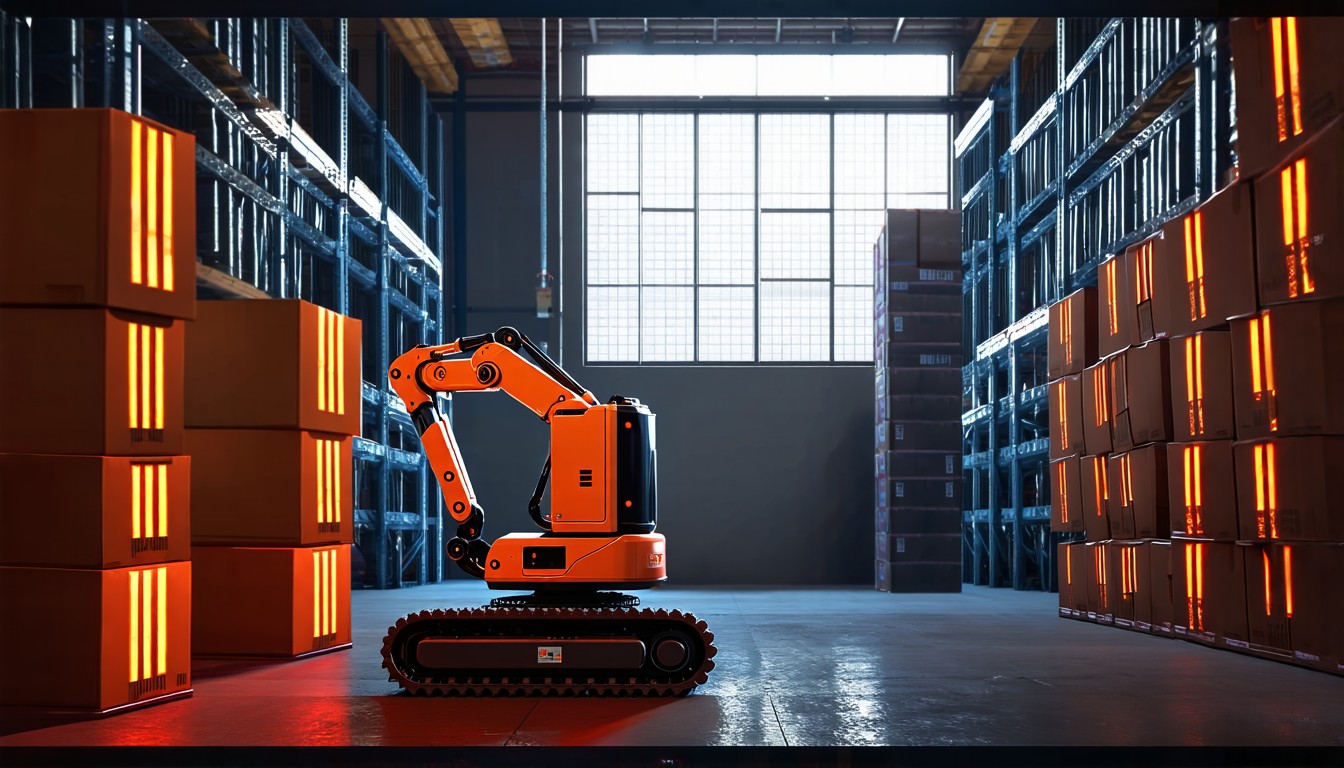
Boston Dynamics integrates voice commands into Spot while startups like Covariant and Embodied focus on warehouse automation, demonstrating the commercial viability of grounded language understanding in industrial settings. Competitive differentiation lies in data quality involving diversity and volume of grounded interactions, as high-quality real-world data remains a scarce resource compared to text data. Incumbents utilize existing cloud infrastructure and large language model expertise to deploy grounded systems rapidly across various platforms and applications. Challengers focus on niche applications with high grounding requirements such as delicate assembly or hazardous material handling where general-purpose models fail to provide sufficient precision. Partnerships with industrial automation firms provide deployment channels and access to specialized hardware required for operating in demanding industrial environments. Commercial deployments feature robotic kitchen assistants from Moley Robotics following recipe instructions using visual feedback to handle ingredients and cooking utensils with human-like dexterity.
Autonomous warehouse robots from Covariant and Kindred interpret natural language pick-and-place commands grounded in 3D scene understanding to sort packages efficiently without explicit programming for every item type. Assistive home robots like Toyota HSR prototypes use grounded language to respond to user requests for fetching objects or cleaning specific areas, relying on real-time environmental perception to handle cluttered home spaces. Performance benchmarks indicate success rates on unseen tasks often double when language models integrate with real-time sensorimotor loops compared to text-only baselines, highlighting the importance of physical feedback. Latency and error rates remain higher than ideal with grounding failures occurring in novel object categories or lighting conditions that deviate significantly from training data. Supply chain dependencies include high-resolution RGB-D cameras, force-torque sensors, and precision grippers which are essential components for capturing the detailed sensory data required for fine-grained manipulation. Compute requirements drive reliance on GPUs and TPUs for real-time multimodal fusion, as processing video and audio streams alongside text generation demands significant parallel processing power.
Training data depends on labor-intensive annotation of human-robot interaction logs where experts label specific moments in sensor streams with corresponding linguistic descriptions to provide ground truth for learning algorithms. Rare earth elements used in actuators and sensors introduce supply risks similar to those in electric vehicle manufacturing, potentially impacting the adaptability and cost of robotic platforms. Simulation infrastructure like NVIDIA Isaac Sim and MuJoCo reduces hardware dependency by allowing developers to train agents in virtual environments before transferring them to physical hardware. Physical constraints include sensor resolution, actuator precision, and latency in perception-action loops, which fundamentally limit the speed and accuracy with which a robot can interact with the world. Economic barriers involve high costs of collecting diverse, high-quality multimodal interaction data, as gathering real-world data is significantly more expensive than scraping text from the internet. Flexibility challenges arise from the combinatorial complexity of real-world environments where the number of possible object configurations and interactions is effectively infinite, making exhaustive coverage impossible.
Energy consumption and computational overhead increase significantly when maintaining synchronized multimodal representations, posing challenges for battery-operated mobile platforms. Simulation introduces sim-to-real gaps that degrade grounding accuracy during transfer to physical systems due to differences in physics, friction, and visual fidelity between the virtual and real worlds. Pure text-based models lack the capacity to resolve referential ambiguity without external context, often failing when instructions contain pronouns or spatial references relative to the environment. Rule-based semantic systems fail to handle the variability and noise natural in real sensory data, leading to brittle performance when faced with imperfect inputs or unexpected situations. Vision-only grounding approaches overlook critical tactile and proprioceptive cues necessary for understanding manipulable objects such as weight or texture, resulting in dropped items or damaged goods. Disembodied chatbots misinterpret spatial, causal, or physical constraints despite fine-tuning on instruction-following data, often suggesting actions that are physically impossible or dangerous due to their lack of grounding in physical reality.
Alternatives lacking feedback between action and perception fail to self-correct misunderstandings, leading to repetitive errors or inability to recover from failures during task execution. Traditional NLP metrics like perplexity and BLEU prove inadequate for evaluating grounded systems as they measure linguistic fluency rather than functional competence in the physical world. New key performance indicators include task completion rate and grounding accuracy measured as alignment between predicted and actual referents in the environment. Evaluation must occur in physical or high-fidelity simulated environments to capture the full complexity of sensorimotor interaction and ensure results generalize beyond the specific test dataset. User trust metrics involving willingness to delegate tasks become critical performance indicators as the primary value proposition of embodied AI is the ability to act autonomously on behalf of humans. Long-term strength measured by performance degradation in novel environments replaces single-dataset accuracy as the standard for strength, emphasizing adaptability over memorization.
Academic labs at Stanford, MIT, and ETH Zurich contribute foundational work on multimodal representation learning that underpins many of the commercial advances in grounded language understanding. Industry partnerships fund large-scale data collection efforts and provide real-world testbeds for validating theoretical models in complex industrial settings. Joint publications increasingly combine theoretical advances with empirical validation on physical platforms to bridge the gap between academic research and practical application. Challenges include misalignment between academic metrics like benchmark accuracy and industrial needs like reliability and safety in unpredictable environments. Adjacent software systems must support real-time multimodal data pipelines and low-latency inference to handle the throughput requirements of continuous sensorimotor processing. Industry standards need updates to address liability when grounded AI misinterprets instructions causing physical harm or property damage, establishing clear protocols for accountability.
Infrastructure requirements include standardized interfaces for sensor fusion and secure communication protocols to ensure interoperability between different hardware components and software modules. Training curricula for engineers must expand to include embodied AI and human-in-the-loop evaluation methods to prepare the workforce for developing these complex systems. Adoption varies by region due to differing regulatory stances on autonomous systems and data privacy laws that affect the collection of sensorimotor data. Manufacturing sectors in East Asia prioritize state-controlled deployment of embodied AI to maintain competitiveness in high-volume production environments requiring precision and speed. Regulations in Europe emphasize explainability and safety, favoring grounded systems with auditable decision trails that allow operators to understand why a specific action was taken. Commercial applications in North America advance faster than civilian oversight frameworks, leading to a rapid deployment cycle in sectors like logistics and consumer services.
Export controls on advanced robotics components affect global supply chains, potentially slowing down the adoption of advanced embodied AI technologies in certain regions. Economic displacement will occur in roles requiring routine language-mediated physical tasks such as warehouse picking or basic assembly, necessitating retraining programs for affected workers. New business models will develop around grounding-as-a-service offering validated language-to-action translation APIs that allow companies to integrate physical intelligence into their products without building proprietary models. Insurance and liability markets will adapt to cover errors stemming from ungrounded versus grounded AI decisions, creating new risk categories for autonomous systems. Demand will grow for professionals skilled in multimodal data curation and robotic safety validation as these become critical limitations in the development pipeline. Future innovations will include lifelong grounding where systems continuously update word meanings through ongoing interaction, allowing them to adapt to new objects or environments without retraining from scratch.
Cross-agent grounding will allow multiple robots to share grounded vocabularies through collaborative tasks, enabling fleets of robots to learn from each other’s experiences in a distributed manner. Connection of predictive world models will simulate outcomes of language-guided actions before execution, reducing the risk of physical damage by allowing the system to virtually test hypotheses. Developers will create universal affordance detectors generalizing graspability across object categories using self-supervised learning on massive datasets of manipulation attempts. Advances in neuromorphic sensing will enable lower-power, higher-fidelity grounding in mobile platforms by mimicking the efficient processing of biological nervous systems. Convergence with computer vision will enable richer visual grounding of spatial and object-related terms, allowing systems to understand complex spatial relationships like “behind” or “under” in cluttered environments. Connection with causal reasoning frameworks will allow grounded systems to distinguish correlation from causation in language, preventing superstitious associations based on spurious patterns in sensory data.
Synergy with digital twins will permit testing and refining grounded language policies in virtual replicas of physical facilities before deployment, minimizing disruption to operations. Alignment with formal verification methods will ensure safety-critical instructions are interpreted within known physical constraints, providing mathematical guarantees on system behavior. Scaling physics limits will involve the speed of light for distributed sensor networks and thermal dissipation in onboard compute, imposing hard boundaries on the reaction times and processing capacity of embodied systems. Workarounds will employ hierarchical grounding with coarse understanding at high levels and fine-grained processing when needed to manage computational load effectively. Energy-efficient architectures will prioritize grounding for ambiguous or high-stakes linguistic inputs to conserve power while maintaining safety. Modular hardware designs will allow incremental upgrades without full system retraining, reducing the total cost of ownership for robotic platforms over their operational lifespan.

Grounding serves as a necessary condition for reliable, deployable AI in the physical world because it anchors abstract symbols in verifiable reality. Absent this, language remains a detached symbol system prone to systematic errors when applied to real tasks involving manipulation or navigation. The goal involves building systems whose linguistic behavior is constrained and validated by interaction with the environment rather than purely statistical correlations found in text corpora. Success requires measurement by functional competence in context rather than linguistic fluency in isolation, shifting the focus from passing reading comprehension tests to completing physical chores reliably. Future superintelligent systems will utilize grounding to anchor abstract reasoning in observable reality to prevent the formation of goals that are logically sound yet physically impossible or nonsensical. This anchoring will prevent drift into incoherent or harmful extrapolations during recursive self-improvement by continuously checking intermediate reasoning steps against physical evidence.
Superintelligent agents will validate hypotheses about the world through controlled experiments rather than internal simulation alone, ensuring their internal model of reality remains accurate despite increasing complexity. Grounded language will enable precise communication of intent between humans and superintelligent agents by referencing shared physical entities and observable states rather than ambiguous internal concepts. These systems will ensure modifications to goals or methods remain tethered to physical consequences, preventing the optimization of proxy metrics that diverge from human values in unforeseen ways. Grounding will act as a safeguard requiring even vastly intelligent systems to check their work against the world before acting on high-level plans derived from linguistic instructions.